The lead detective in a case that sent an innocent man to prison for more than two decades, largely due to missing and flawed evidence, is now one of Richard Coleman’s top dogs at the Chatham County Sheriff’s Office.
Missing evidence.
Faulty photo lineups.
Untruthful testimony under oath.
A deficient records custodian.
Brady violations.
An inability to rule out bad faith.
A revoked POST certification.
The list is a mere snapshot of the defects in the criminal case that landed Sandeep “Sonny” Bharadia in a Georgia prison for crimes he did not commit. But just as concerning as the case itself is where the detective behind it all finds himself today – back in the saddle with more responsibility than he had before.
In November 2001, Henry “Trey” Conners and Richard Coleman were both employed by the Thunderbolt Police Department in Chatham County when a woman reported that her home had been burglarized – an act she interrupted – and she had been sexually assaulted.
The victim wrote a ten-page single spaced victim statement for police, describing in detail things like the batting gloves worn by the attacker, the knife, and the attacker himself.
After roughly one week, Conners had two suspects for the crime: Sterling Flint, because he was in possession of all the items stolen from the victim, and Bharadia because Flint, when caught with the stolen items, told police he got them from Bharadia.
“When Detective Conners went over to a place on Betty Drive to investigate something else, guess what he found? You know, all the stuff – – all her stuff in a house on Betty Drive, the knife she had described, the gloves that she had described that he wore, her computer, her suitcase, her jewelry. And that house belonged to Sterling Flint…Flint’s girlfriend explains to Detective Conners that ‘all stuff is my boyfriend’s” all that stuff is Sterling Flint’s. And everybody is under the impression that all of the – – all of the stolen property, all of the burglary tools that are found over it…over at Sterling Flint’s girlfriends are Sterling Flint’s because that‘s what makes sense. Everybody is under that impression until, you know, Sterling Flint is transferred over to Chatham County from where he was…He was wanted everywhere. Sterling Flint comes over here from, comes to Chatham County, Detective Conners finally interviews him, and that’s when,…you know, that’s when Detective Conners is put on to Mr. Bharadia.” (Nov. 5, 2012 hearing – p 39)
Flint was in Thunderbolt and had a six and a half hour window during which he was unaccounted for on the day of the crime, including the window when the assault happened. At the time of the assault, Flint had been arrested thirteen times in six different jurisdictions, including two in Chatham County. Bharadia was more than 250 miles away in Lithonia, Ga and on the day of the crime, was in the presence of a number of individuals for work and for leisure from early in the morning until late at night.
The day after the assault, Bharaida and his girlfriend drove from Atlanta to Beaufort, South Carolina to pick up his vehicle, which had been reported stolen and was impounded. Flint and his girlfriend had dinner with Bharadia and his girlfriend in Savannah and Flint drove the Tahoe back to Atlanta for Bharadia. As they neared Atlanta, Flint fled with the Tahoe and refused to return the vehicle, despite repeated calls. According to police reports, Flint threatened to kill Bharadia and his family if he reported the vehicle stolen. The vehicle was later recovered after a high speed chase by Flint and police in Atlanta and a string of burglaries in Cobb County.
Detective Conners Presents a Photo Array/Lineup to the Victim
Issue: The copy of the photo arrays presented to the victim/eyewitness by Conners went missing and could not be located or produced in the initial trial
- Initially, the victim was shown a photo array with Sterling Flint’s photograph and she circled it as someone who looked ‘familiar’ to her. She also identified another black man from the photo line up.
- The following day, she was shown another photo array and she selected Bharadia.
- Bharadia’s attorney later called the photo lineup with Bharadia “laughably bad and extremely suggestive, with Mr. Bharadia’s photo jumping off the page.”
- The identification of Bharadia was the basis of the warrant for Bharadia’s arrest.
Despite issues with the photo lineup and assertions of valid alibis, in March of 2003, Bharadia was indicted for Aggravated Sodomy, Aggravated Sexual Battery, Theft by Receiving Stolen Property, and Burglary. Flint was also indicted by a grand jury on charges of Theft by Receiving Stolen Property and Burglary, but due to his criminal history, he was facing Life without Parole if convicted. Prosecutors offered Flint a deal of Theft by Receiving in exchange for his testimony against Bharadia – a five year sentence, with three years to serve in prison.
A week before trial, the state offered Bharadia a ten-year sentence if he agreed to plead to Aggravated Sodomy and Burglary. The other two charges would be nolle prossed, but Bharadia declined.
In June 2003, three months after the indictment, Bharadia’s case went to trial.The state’s case relied on Flint’s testimony, the testimony of Detective Trey Conners, and the victim.
Missing Evidence
Issue: The audio and video recordings of the interview between Detective Conners and Bharadia went missing and were never provided to the defense. At trial, the state relied on the testimony of Conners/his recollection of the interview.
During the 2003 trial, Conners testified that Bharadia told him in an interview that he possessed and transported stolen property in his vehicle. But a deputy and a lieutenant from South Carolina both testified that Bharadia’s vehicle was impounded in South Carolina at the time Conners claimed it was used to transport stolen items in connection with the assault.
Conners also testified that he recorded the interview with audio and video, but he did not place the tapes into evidence. When asked if he knew where the tapes were, he replied ‘No sir.’ At the time of the investigation, Conners was the Records Custodian for the Thunderbolt Police Department and was tasked with preserving evidence. After 25 years, the tapes still have not been located.
Also of concern was the testimony by Conners that he did not receive any other information about Bharadia during his investigation. Contrarily, he received information from Cobb County Police about both Bharadia and Flint, including that Flint had stolen Bharadia’s vehicle, which would have provided context to the state of Bharadia and Flint’s relationship at the time Flint credited Bharadia with the crime.
Verdict, Sentence, Appeals
At trial, a judge acquitted Bharadia of Theft by Receiving Stolen Property in a directed verdict, but a jury found him guilty on the remaining charges. He received a sentence of Life without Parole for Aggravated Sodomy and twenty years for aggravated Sexual Battery and Burglary to be served concurrently.
For years, Bharadia sought a new trial, filed appeals, and petitioned for a writ of habeas corpus before he was granted his Extraordinary Motion for Post-Conviction DNA Testing.
The Georgia Innocence Project had to petition a Superior Court Judge for a court order to process the DNA found on the gloves by running the results through the CODIS database, a system that is entirely within the control of the state/prosecution. At the time of the trial, the defense was aware that ‘other DNA’ was on the gloves, but they did not have the ability to run the evidence from the batting gloves through CODIS to establish to whom, specifically, the DNA belonged.
Ultimately, the gloves, which matched the description of those worn by the attacker during the assault, contained DNA which matched the DNA sample on record for Sterling Flint.
In 2012, ADA Shalena Cook Jones argued against a Motion for New Trial for Bharadia, saying the CODIS hit offering a DNA match to another individual was ‘not new evidence’ because the DNA was on the gloves during the initial trial, they just didn’t know who it belonged to. A judge agreed with the state and denied the request for a new trial.
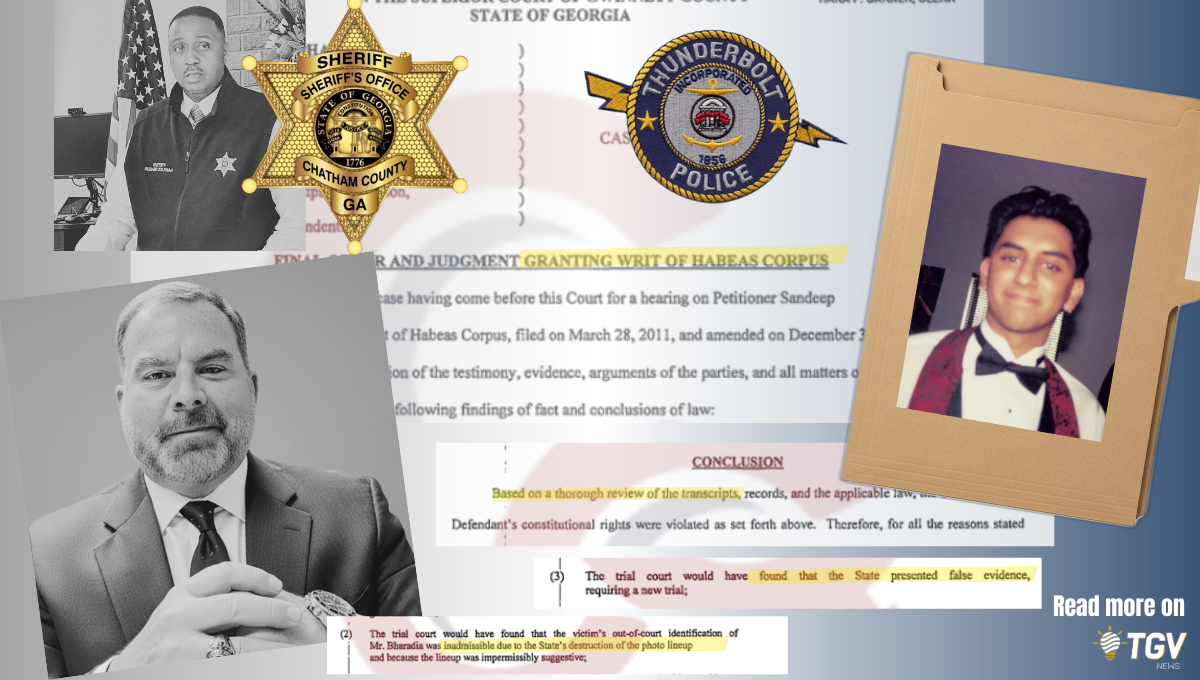
But in April 2024, the case took a turn when Gwinnett County Superior Court Judge Laura Tate granted a Writ of Habeas Corpus on the basis of the DNA-related issues, but also recognized the ineffective assistance of counsel at the appellate level. The Court noted that with effective counsel, the trial court would have found the photo line up inadmissible because of the destruction of documents and issue would have been taken with the presentation of false evidence and the suppression of material, exculpatory evidence.
Bharadia was entitled to a new trial, the court found. In August 2024, a judge set a bond for Bharadia, pending a new trial and he was released shortly thereafter. Ultimately, in May 2025, the state filed paperwork to nolle prosse the case, declining to re-try Bharadia.
Sandeep “Sonny” Bharadia spent twenty-two years in prison for a crime he did not commit. But what about the detective who helped put him there? Interestingly, Conners himself was arrested just three weeks before he testified against Bharadia in 2003.
Conners Loses POST Certification
According to POST records obtained under the Georgia Open Records Act, Conners became a law enforcement officer in January 1992 when he was hired by the Savannah Police Department. He worked there until September 1993 and was out of law enforcement until May 1994 when he was hired by Tybee Island PD. In May 1996, Conners resigned from Tybee Island PD and was out of law enforcement until May 2000 when he went to work for Thunderbolt PD.
In May 2002, Conners left Thunderbolt PD and went to work for Savannah PD. Fifteen months later, in August 2003, he resigned in lieu of termination and in 2004, POST revoked Conners’ certification.
According to his POST file, Conners was arrested for misdemeanor Battery (Family Violence Act) after police responded to his home in June 2003. A woman had noticeable swelling on her forehead, right cheek bone, and upper lip. There was also dried blood around her mouth and nose, a bedside table with a broken leg, and indentations in the wall with scuff marks.
“According to information reported to police by the spouse on the night of the incident, the officer grabbed [her] by the hair and pulled [her] from the bed. The officer punched [her] in the face several times with his fists. [She] said the officer would not allow [her] to leave the residence, and once [she] got away from the officer, [she] left through a bedroom window and went to a neighbor’s house for help.” -POST file case summary from 2003
Conners entered a plea under the First Offender Act in November 2003. He was sentenced to a term of 12 months probation, ordered to attend counseling by a counseling agency, and was prohibited from making threats or committing violence against his spouse. The POST Council Chairman recommended revoking his certification in April 2004 and the POST Council did so formally in June 2004.
Conners Returns to Law Enforcement
POST records show that on September 23, 2025, Conners began working as a deputy sheriff at the Chatham County Sheriff’s Office under Richard Coleman. A month later, in October 2025, POST reinstated Conners’ certification with a placement on probation for 24 months.
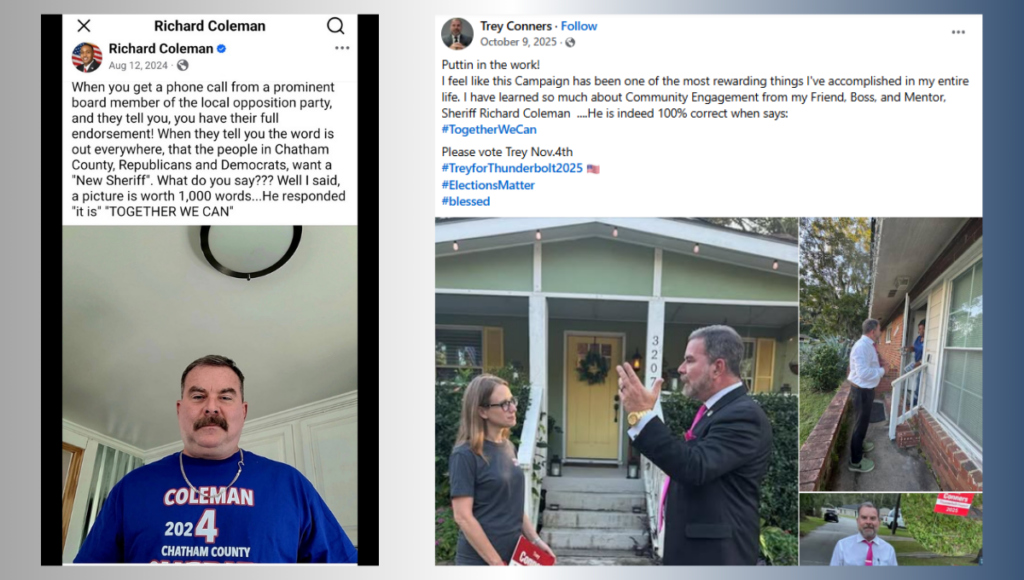
According to records obtained by TheGeorgiaVirtue, however, Conners was working for the agency well before that. A roster provided last summer following an Open Records Request shows that Conners was hired on February 18, 2025. His location description was listed as “Sheriff.”
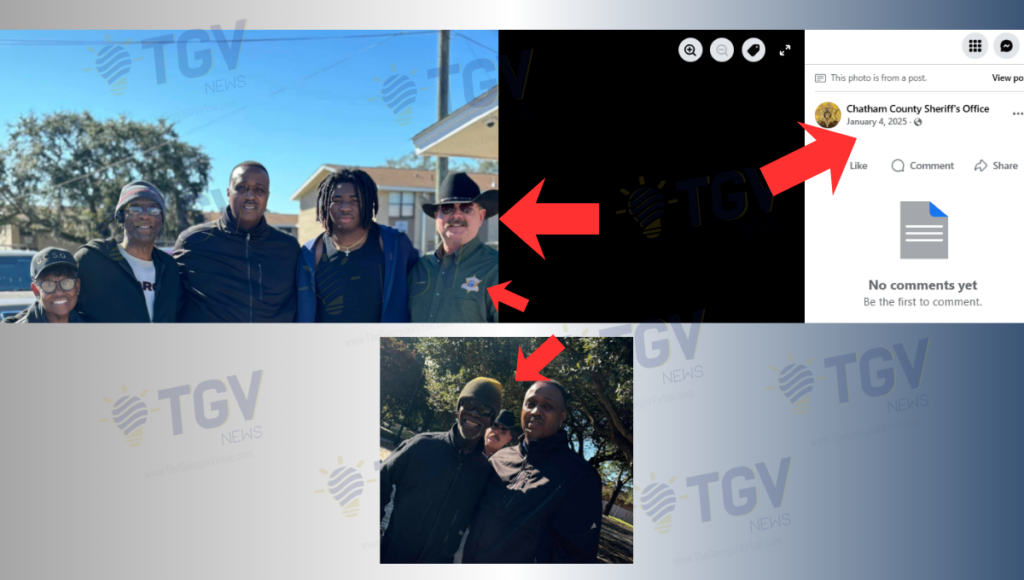
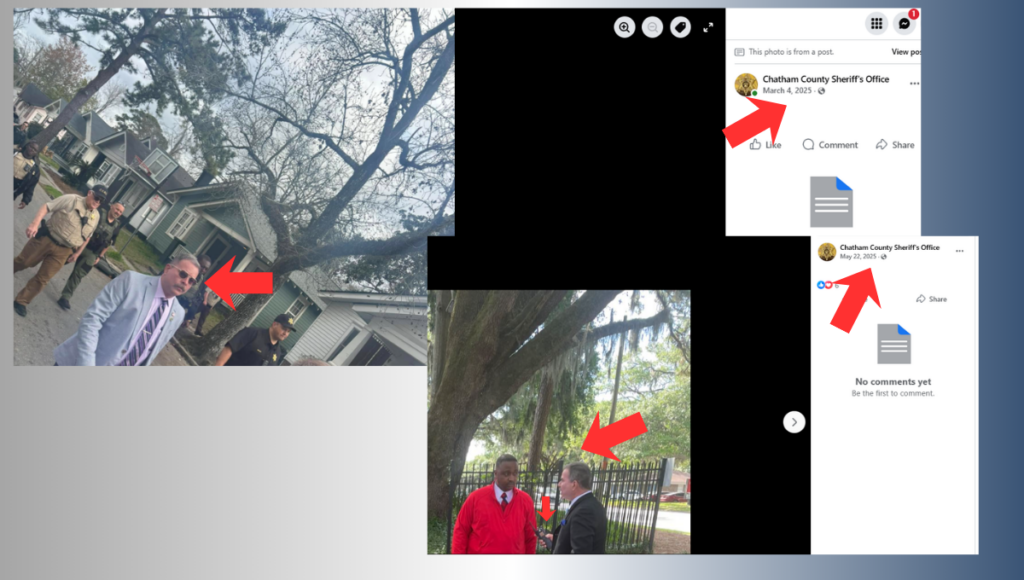
An updated roster provided to TheGeorgiaVirtue.com in December 2025 revealed that Conners has since been assigned as the ‘Evidence Custodian’ for the Chatham County Sheriff’s Office.
Since his hiring, Conners has been publicly tied to high profile cases, which sources close to Coleman say could impact the cases as they move through the court process. Most recently, Conners was photographed escorting one of the suspects in the Pooler Walmart assault. The placement has also caused internal strife and distrust within the office, sources says, over concerns of Conners’ involvement in cases handled by other investigators.
Law enforcement officers, like prosecutors, are required to disclose evidence that is favorable to the defendant, established in the U.S. Supreme Court case Brady v. Maryland. If a court finds that an officer withheld, failed to document, or failed to disclose exculpatory or impeachment evidence, that officer’s credibility can be permanently damaged. The credibility of an officer involved in a criminal case is also heavily scrutinized by defense attorneys and if an officer can’t be trusted on the stand, their usefulness in criminal cases drops significantly.
If a Brady violation contributes to a wrongful conviction or extended detention, it can also lead to civil rights lawsuits under 42 U.S.C. § 1983. While prosecutors often have broad immunity, officers typically have only qualified immunity. If a court finds that an officer knowingly suppressed material exculpatory evidence, that protection can erode.
In November 2025, Bharadia filed a federal lawsuit for malicious prosecution, among other things. The Atlanta Journal Constitution reported that Conners said he had no recollection of the Bharadia case and declined to comment on the allegations.