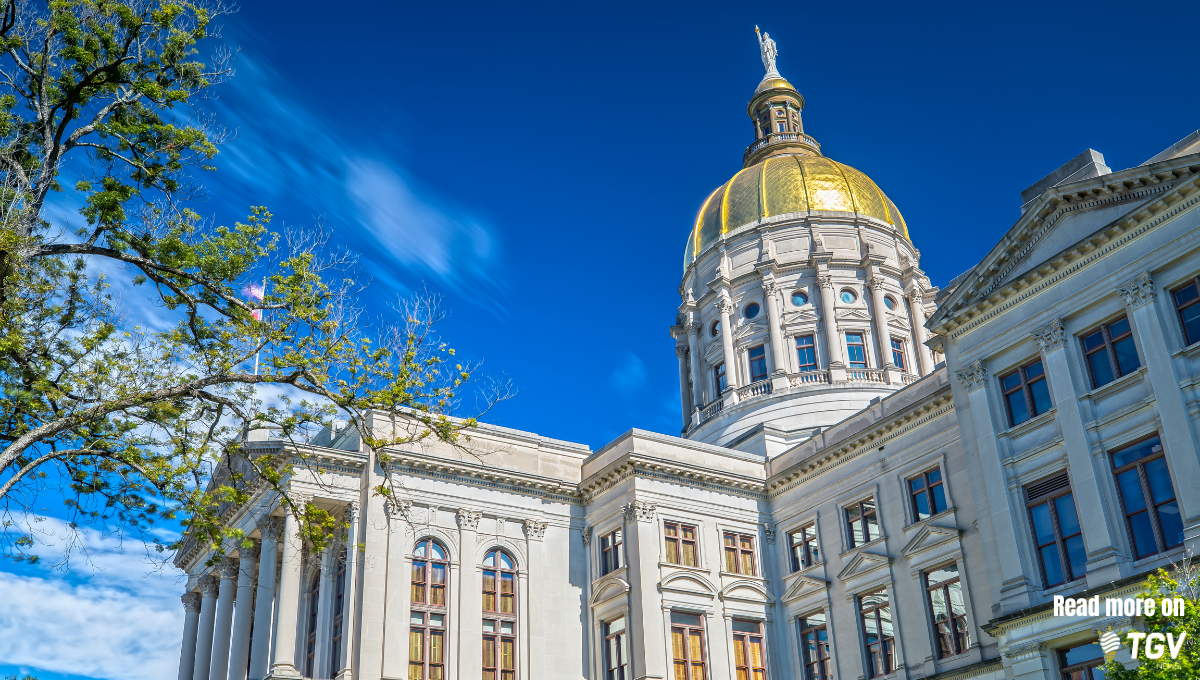
Georgia Governor Brian Kemp has broadened the agenda for the Georgia General Assembly’s special legislative session scheduled to begin June 17, one day after the June 16 primary runoff election.
Kemp recently expanded the scope of the special session to include Senate Bill 33, legislation that would authorize cities and counties to seek voter approval for an additional one-cent local sales tax designed to reduce property tax burdens. Under the measure, the tax could only be implemented if approved by local voters. But the special session topic could mean lawmakers could move legislation to allow local governments to pursue the tax option themselves, instead of with voter approval.
Kemp first announced the special session in May following a recent U.S. Supreme Court ruling that altered the legal landscape surrounding redistricting and the Voting Rights Act. The governor’s call directs lawmakers to consider revisions to Georgia’s congressional, State House, and State Senate district boundaries for future elections. Any changes lawmakers approve would begin in the 2028 election cycle.
During the legislative session earlier this year, lawmakers failed to address an issue tied to the ballot-counting system. Legislators face a July 1 deadline for changes to move away from the QR code system Georgia currently uses. Local election officials have warned lawmakers that replacing existing voting equipment will take time as well as additional funding, both of which could be problematic with the November 2026 election.
Special sessions are relatively uncommon in Georgia and can only be called by the governor. Unlike regular legislative sessions, lawmakers are limited to considering subjects specifically identified in the governor’s proclamation.
The proclamation now includes the following topics:
- To consider enacting, revising, repealing, or amending general law for the division of the State into appropriate districts from which members of the Georgia State Senate, the Georgia State House of Representatives, the United States House of Representatives to the United States Congress, or any other state office elected by district, in light of the United States Supreme Court decision in Louisiana v. Callais, 608 U.S. (Apr. 29, 2026), to take effect for the 2028 election cycle.
- To address issues created by the July 1, 2026, effective date for the changes to Code Section 21-2-379.23, enacted by 2024 Georgia Laws Act 697 (S.B. 189).
- Election matters
- For enacting such local Acts as prescribed by Code Section 48-8-109.52, enacted by 2026 Georgia Laws Act 461 (S.B. 33).
- Sales Tax legislation
- To ratify the provisions of the Executive Order dated May 15, 2026, number 05.15.26.02, in the official records of the Office of the Governor, suspending the collection of motor fuel and diesel fuel taxes pursuant to Code Section 45-12-22 beginning Wednesday, May 20, 2026, at 12:00 a.m. and expiring Tuesday, June 2, 2026, at 11:59 p.m.
- For the Senate to consider and confirm various appointments made by the Governor since the adjournment of the regular session of the General Assembly on April 3, 2026.