Jacquelyn Walker notarized the signature on a contested will filed by a DeKalb County judge. Two years earlier, she notarized the signature of a dead woman, The Center Square found
By Johnny Edwards | The Center Square
(The Center Square) – The notary public who certified that a Georgia judge’s brother signed a will 12 days before his death once certified another signature for the judge’s family—by a dead woman, an investigation by The Center Square found.
After The Center Square started asking questions about her work, Jacquelyn Walker has been stripped of her notary license.
Two years before DeKalb County Judge Rhathelia Stroud filed a family will that’s now being challenged as an alleged forgery, the same notary verified the signature of the judge’s sister-in-law on a different legal document, a warranty deed transferring ownership of a timeshare vacation resort property. Walker officially recorded that the woman appeared before her with the signed deed in November 2023—three weeks after the woman had died of cancer, records show.
That discrepancy prompted the agency that commissioned her, the Fulton County Clerk of Superior and Magistrate Courts, to revoke her notary status on Tuesday. The revocation notice says Walker’s commission is “hereby revoked, effective immediately” and orders her to destroy her notary stamp. Walker will have a chance to appeal.
“I’m looking at the warranty deed. I see the death certificate,” the elected Superior Court clerk, Ché Alexander, told The Center Square. “It’s clear that this was notarized after the person had passed away.”
Walker, a longtime acquaintance of Judge Stroud, would later notarize a signature on the will of the judge’s brother, which his children say isn’t their father’s handwriting. The notary’s role is part of a continuing investigation by The Center Square into Judge Stroud’s actions around the will that, if upheld as valid, would allow her to take control over her brother’s estate.
Falsely notarizing a document isn’t just cause for discipline by the commissioning agency, it would also violate state law, according to an official with the National Notary Association.
“It definitely doesn’t look good,” Brooke Merritt, the professional organization’s government affairs and policy planning director, said after reviewing the 2023 warranty deed. “Notaries are prohibited from notarizing if they know that a document is false.”
The Superior Court Clerk’s office received copies of the 2023 deed and the woman’s death certificate in March from the judge’s niece who is challenging the will, but didn’t launch an investigation because the niece didn’t include a police report. Alexander said while there’s no written policy or state law requiring that, she needs a parallel law enforcement investigation to protect herself from civil liability. And if the allegations are true, the North Georgia property transaction behind the deed has to be investigated too, she said.
“If that was a fraudulent document and they did that three weeks after she died, that warranty deed should be null and void,” Alexander said in July. “But somebody has to prove that.”
The niece initially balked at the clerk’s requirement, saying she didn’t understand how she could call police about a deed from her late father’s files that she wasn’t party to, much less a victim of. But then she decided to contact the Atlanta Police Department in late July. She resubmitted her complaint to Alexander’s office, this time with a police report attached.
“It’s major, because that’s her credibility,” Gemina Stroud said after The Center Square informed her of Alexander’s decision to decommission Walker. “If she signed before like that, for the same family, why would I believe this time would be different?”
The notary involved repeatedly declined to speak about this story. For months Walker has not responded to phone messages or emails, and when a reporter for The Center Square knocked on the door of her Atlanta home on July 21, she said, “I don’t have no comment,” and closed the door.
The disputed will
The notary public’s role in the 2023 deed could have bearing on the fight the judge’s niece is waging in DeKalb County Probate Court over the 2025 will, a criminal law professor said.
“If your argument is that this is a forged document, that that’s not his signature, and you’ve got a notary who has been shown to have falsely notarized a previous document, it’s very relevant,” J. Tom Morgan, a professor at Western Carolina University and a former DeKalb County District Attorney, said. “It does help substantiate the opinion that this is a forged signature.”
Merritt, of the National Notary Association, said unless someone stole the seal and forged her signature, the notary should be under scrutiny.
“Based on the face of the document, we can’t tell exactly what scenario occurred here,” Merritt said. “But we can absolutely tell that further investigation is warranted because Carolyn Stroud could not have acknowledged her signature in November if she passed away in October.”
Judge Rhathelia Stroud is both a DeKalb County Magistrate Court judge and chief judge of the Decatur Municipal Court. Both are appointed positions. For Magistrate Court, Stroud presides over Misdemeanor Mental Health Court, a diversion program for low-level offenders. Municipal Court involves traffic offenses, parking tickets, local ordinance violations, and misdemeanors.
Walker, the notary, has decades of history with Rhathelia Stroud, attending high school with the judge and her sister, according to social media photos viewed by The Center Square. Federal court records also show Judge Stroud, as a practicing attorney, represented Walker when she filed for bankruptcy in 1998.
Judge Stroud’s older brother, Johnny “Pokey” Stroud, died in her Decatur home Sept. 17 after a battle with colon cancer. The judge filed his will in November, which named her executrix and authorized her to sell his home and use proceeds to compensate herself for caring for him during his illness.
Walker notarized the man’s signature on an affidavit attached to the will, which is dated Sept. 5, when the brother was on his deathbed in Judge Stroud’s home under hospice care.
The will left nothing to the man’s two adult children, other than asking his sisters to share his personal belongings with his children “at their discretion” and to divide up leftover proceeds from the house sale equitably between the children “as determined by my Executrix.”
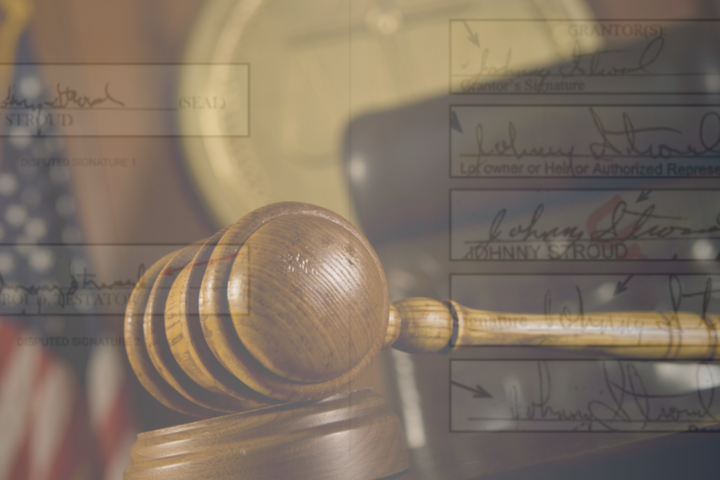
Johnny Stroud’s daughter, Gemina Stroud, has challenged the will in Probate Court, calling it a “forgery” and charging that her father was too “physically debilitated and cognitively impaired” to have executed a will that day. She also hired a forensic document examiner to compare her father’s signatures on the will to seven earlier signatures, with the examiner’s written report concluding, “Someone did indeed forge the signatures of Johnny Stroud on the questioned document.”
Judge Stroud, through her attorney, has called her niece’s allegations “unsupported” and “factually and legally deficient,” according to correspondence in the case provided by the niece.
The Probate Court case
The challenge to the will faces a high bar.
Emory University law school professor Dave Fagundes, who teaches courses on wills, trusts, and real estate transactions, said Georgia sets a high standard for proving lost mental capacity. A will with two witnesses and a notarization is hard to challenge, he said, and proof of a prior bad act by a notary probably wouldn’t be enough invalidate a will entirely.
“It certainly raises questions about credibility,” Fagundes said.
Judge Stroud has not responded to repeated messages from The Center Square over the past two months—left on her personal phone, at both of her judicial offices, and by personal and county email.
The first attorney representing her in the probate case, Dana Ashford, also did not respond to repeated interview requests. She withdrew from the case recently and Stroud’s new attorney, Louis Levenson, also has not responded.
The dispute over Johnny Stroud’s will triggered recusal orders that removed every DeKalb County probate and superior court judge because the person who filed the will holds a judicial seat in the county. The case has been transferred to Fulton County Probate Court, with a pre-trial hearing scheduled Aug. 27.
Gemina Stroud also filed a complaint against her aunt with the state’s judicial watchdog. That complaint has already been dismissed. The Judicial Qualifications Commission, which investigates allegations against judges at all levels of the court system and can recommend sanctions by the state Supreme Court, declined to take up the matter, according to correspondence also provided by the niece. The JQC’s investigative panel said she had not provided “evidence sufficient to substantiate a violation of the Code of Judicial Conduct.”
The commission declined reconsideration and would not discuss the case with The Center Square, citing state law making complaints confidential.
The 2023 warranty deed
Gemina Stroud has already brought up the prior notarization of her dead stepmother’s signature in the court case with her aunt.
In a March letter responding to the niece’s demand that Judge Stroud withdraw the will, the judge’s first attorney called the allegations about the 2023 deed “a red herring” with “no bearing on the execution of the Decedent’s Will.”
“The credibility of Ms. Walker,” Ashford wrote, “along with that of the two attesting witnesses, is a matter for the Court to determine based on testimony and evidence.”
The niece alleged in her challenge filed in Probate Court that the two witnesses, as well as the notary, are “close personal friends or long-standing acquaintances” of Judge Stroud and were not impartial. Efforts by The Center Square to reach the two witnesses have been unsuccessful.
The niece told The Center Square she came across the earlier document notarized by Walker while searching for samples of her father’s signature to provide to the handwriting expert, and she provided it to The Center Square.
The deed, filed in Habersham County, shows her father transferring a timeshare property in the North Georgia mountains, owned by him and his wife Carolyn Stroud, back to the resort developer. The final page has both Johnny’s and Carolyn’s names signed.
Gemina Stroud said she also found a letter from Holiday Inn Club Vacations Incorporated, dated Nov. 9, 2023. It gave her father 15 business days to relinquish ownership if he wanted to be freed of financial responsibility for maintenance charges, club dues and other fees.
Carolyn Stroud died Oct. 23, according to both her death certificate and tombstone.
But Walker’s notarization says the man and wife “are personally known to me” and she took their acknowledgements, meaning they presented the document and stated they’d signed it. Walker’s stamp and signature are dated Nov. 13.
“You should not notarize a person’s signature if they’re not in front of you, period,” Alexander, the Fulton County clerk, said in July. “‘Dead’ is not even a conversation.”
Nothing on the recorded 2023 warranty deed indicates Judge Stroud had any involvement.
Commission revoked
Alexander said the deed carries a second problem. Walker signed it as both an unofficial witness and a notary. Georgia law forbids notarizing a document “when the notary is a party to the document” as this would “impugn and compromise the notary’s impartiality.”
The clerk’s office mailed and emailed the notice to Walker informing her she’s been decommissioned and giving her 10 days to turn in her appointment papers and destroy her notary seal. The notice also gives her the right to an appeal, which would involve a public hearing where the notary could present her side of the story.
The clerk said she’s only held one such hearing for a notary public during her three years in office and has previously decommissioned about 10 notaries.
“That is such a major step forward,” the complainant, Gemina Stroud, said. “It feels like somebody’s finally listening.”