The Bulloch County Board of Commissioners filed an Answer in Superior Court this week in response to a zoning-related lawsuit over land use for a property in unincorporated Bulloch County.
The suit stems from the denial of a conditional use permit application by Samuel C. Lovett filed earlier this year.
Background
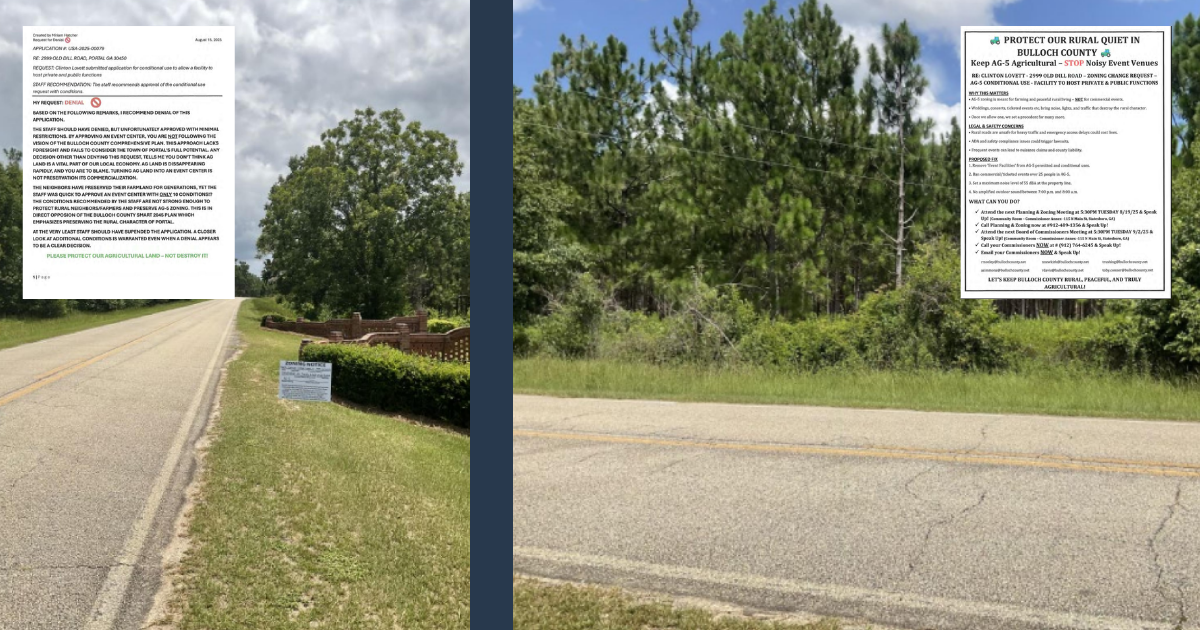
In late summer of 2025, Lovett submitted an application for a conditional use permit for a property on Old Dill Road outside of Portal. Specifically, Lovett wanted to operate an event venue on the property to host private and public functions.
County staff recommended approval of the application, but on August 19, 2025, the Planning and Zoning Commission voted 3-1 to recommend denial to the Board of Commissioners. Members Charles Chandler, Ryne Brannen, and Betsy Riner voted to deny the permit application with member Adam Bath opposing. Two members of the commission were recused from voting (Schubert Lane and Matthew Lovett).
On September 2, 2025, county commissioners heard from neighbors on Old Dill Road who asked commissioners to deny the application, citing everything from current land use to infrastructure needs. After a lengthy dialogue between commissioners, a motion was made by Commissioner Anthony Simmons to approve the application with conditions. It was seconded by Commissioner Ray Mosley but failed in a vote of 2-4. A motion to deny the application was then made by Commissioner Nick Newkirk and approved 4-2 with Simmons and Mosley opposing the denial. The denial was formally certified the following day on September 3.
On October 3, Lovett served the county with a suit filed in Bulloch County Superior Court, asking a judge to reverse the decision made by the Board of Commissioners and grant a declaratory judgment allowing the property to be used as an event venue.
The complaint alleged that the county’s decision was arbitrary, that opposition of neighbors did not constitute substantial evidence sufficient to overcome staff findings, Lovett’s rights were violated, the decision was not related to health, safety, or welfare, and the decision was in conflict with staff reports, planning standards, and the Smart Bulloch 2040 plan.
You can read TGV’s previous coverage on this issue, review exhibits from the suit, and see the conditional use permit application here.
Commissioners voted 4-2 on October 21 to engage the Cumming-based firm Jarrard & Davis LLP to represent the county in the litigation. Commissioners Mosley and Rushing voted NO on hiring the outside firm.
Response from the County
Molly Esswein of Jarrard & Davis LLP filed the county’s Answer on November 3.
Among the responses included in the county’s Answer, the Board contended that:
- Lovett’s complaint does not state a claim against the Board of Commissioners for which relief can be granted.
- The Bulloch County Board of Commissioners is not an entity capable of being sued, due to sovereign immunity, qualified immunity, and a lack of subject-matter jurisdiction, among other things.
- Lovett did not provide notice of its constitutional challenge during the rezoning process prior to filing a complaint in Superior Court.
- Lovett has not been deprived of any ‘constitutionally protected life, liberty, or property interest without due process of law’ and the county did not violate Lovett’s rights.
- The decision to deny Loevett’s conditional use permit was not arbitrary, capricious, unreasonable, or discriminatory.
- The benefit to public health, safety, morality, and general welfare outweighs any detriment to Lovett.
- The Board of Commissioners did not abuse its discretion in rendering the decision on Lovett’s permit and the considerations for approval of a conditional use permit were properly applied.
- The Board of Commissioners has not taken any property rights of Lovett and there’s been no physical invasion of his property. “[T]he property will yield a reasonable economic return under its present land use designation.”
- The denial of Lovett’s permit application was not discriminatory compared to owners of other similarly situated properties and does not deny equal protection under the law. “All property is inherently unique, and, therefore, no equal protection claim will lie with respect to treatment of [Lovett’s property].”
- Lovett’s claim against the Board should be dismissed.
- Lovett should be responsible for the Board’s attorney’s fees and expenses for litigation under OCGA 9-15-14 because there is a “complete absence of any justiciable issue of law or fact that it could not be reasonably believed that a court would accept the claims against the county” and the complaint “lacks substantial justification and was interposed for delay or harassment.”
In summary, the county asks that Lovett’s complaint be dismissed.
Records show that Lovett’s attorney, Francys Johnson, was provided with a copy of the Answer, as was county attorney Jeff Akins.