This article is part of a series about civil asset forfeiture cases in the Ogeechee Judicial Circuit, which encompasses Bulloch, Effingham, Jenkins, and Screven counties.
A case involving misdemeanor drug offenses, allegations of a drug mule, a sizable amount of cash, and a fraud scheme out of Florida has put prosecutors at odds with law enforcement in Bulloch County over the seizure of more than $72,000.
Criminal Case Against Seandale Michael Coore
At 10:00 p.m. on July 11, 2025, a deputy with the Bulloch County Sheriff’s Office, stopped 29-year-old Seandale Michael Coore of Windemere, FL on Highway 67 at Brooklet-Denmark Road. According to a report, the “overpowering odor of marijuana alerted the sense of smell of [the deputy]. Due to this reason the driver, identified as Seandale Coore, was asked to exit the vehicle so a probable cause search could be completed.”
Crime Suppression Team (CST) Investigator Donald White responded to the roadside and later wrote in his report that “…suspected marijuana was located in the ash tray of the vehicle. There was also rolling papers and a rolling tray located in the passenger side seat. Other items located were a large sum of cash in a black book bag, along with a Tan Glock 19 located in the center console and a Black Sig Sauer 40 CAL pistol in the passenger side floor board. After discovering these items, DEP Lanier requested my assistance to investigate these findings further.”
White wrote that he asked Coore how much money was in the bag and where it came from, to which Coore replied that he received approximately $70,000 from the sale of property in Texas due to his grandfather’s death. Coore did not have any paperwork to substantiate that claim, but said he met a cousin in Augusta to retrieve the money.
“It was at this time that I found Coore’s explanation to make no sense to me whatsoever,” the report reads, noting that Coore was then read his Miranda rights and agreed to continue talking. White told Coore he wanted to believe his story but there were parts that didn’t add up. He asked for consent to search Coore’s phone and Coore agreed.
“I could find no evidence of a sale of land that would prove further the money in Coore’s possession was in fact obtained legally,” White wrote. He said he located communication in a TELEGRAM app which appeared to be between Coore and an Asian female speaking about a place to meet, which prompted White to ask Coore if he would like to explain the truth. “Coore stated he had nothing more to say” and was then arrested. His vehicle was impounded and he was transported to the Bulloch County Jail.
On July 14, 2025, Coore was again interviewed by Investigator White. During this interview, he admitted that the suspected marijuana roaches in the ashtray were his, as was the rolling tray. White also wrote that Coore said “he couldn’t account for the money he had on him, he didn’t have any paperwork to prove where the money came from, he didn’t want the money or his guns back, and he just wanted to get out of jail and out of Georgia.” White wrote that due to his training and experience, he believed that Coore was selling narcotics because of pictures of large amounts of marijuana on his cell phone, but Coore denied doing so, noting only that he does smoke marijuana himself.
Ultimately, Coore was cited for two traffic offenses – Window Tint and Failure to Maintain Lane – and warrants were taken on two misdemeanor charges – Possession of Marijuana (less than 1 ounce) and Possession of a Drug Related Object. Warrants stated Coore had “with the intent to use marijuana rolling paper and rolling tray used for converting and preparing narcotics for distribution or consumption.” The Sheriff’s Office also seized $72,000 from Coore’s vehicle and $846 from his person.
Coore remained in the Bulloch County Jail until July 18, at which time he bonded out and was released.
Misdemeanor cases are prosecuted in state court by the Solicitor’s Office before Judge Joseph Cushner. The case was formally accused in August of 2025. The charges remained the same but the Possession of a Drug Related Object charge mentioned only that Coore had rolling papers in his possession. The Accusation did not mention anything about converting or preparing narcotics.
In December 2025, Coore requested a bench trial in Bulloch County State Court. As of publishing, he has no scheduled court date and the case has not been formally adjudicated.
Simultaneous to the criminal case, the sheriff’s office filed paperwork with the district attorney’s office to begin the asset forfeiture process on the $72,846 in cash.
What Is Civil Asset Forfeiture
Civil Asset Forfeiture is a process in which the state is authorized to seize property when it is believed that the property is connected to criminal activity. The practice was originally created as a means of seizing property connected to large criminal enterprises like drug cartels and well-connected crime networks, but over the years, its use has been expanded considerably. In some instances, property is seized but no criminal charges are made.
When a law enforcement agency seizes property, it then petitions the prosecutor to begin the forfeiture process. If the prosecutor agrees that the forfeiture meets certain criteria and also wishes to pursue the complaint, a claim is made against the property itself and the process moves through the formal court proceedings.
In order to avoid forfeiture, the owner is required to prove that the property was not part of the criminal act. Because it is not a criminal proceeding, there is no public defender’s office to assist. The standard is also lower, in that a judge must only find by the preponderance of the evidence – not beyond a reasonable doubt – that the property is linked to criminal activity.
Among the criteria is a legal standard that the value of the property seized must be proportional to the seriousness of the offense.
Traditionally, the process happens before the related criminal case is adjudicated, which has long raised questions about the practice. Law enforcement officials, however, contend that the practice is essential to stopping criminal activity.
If the property is successfully forfeited, the arresting agency receives 90% of the funds (or proceeds from sale or surplus) and the prosecuting office receives 10%. State law strictly limits what the money can be used for, namely investigative equipment, specialized gear, training, technology, crime prevention programs, drug interdiction programs, and victim-witness programs.
How does the Bulloch County Sheriff’s Office use seized funds?
According to records provided in an Open Records Request, in recent years, the Bulloch County Sheriff’s Office has used drug funds to purchase vehicles, police K-9s, and equipment used in the course of investigations. In the time period of the request, BCSO reported a little more than $188,000 in related purchases.
Sheriff’s Office Seeks Forfeiture of Cash in Coore Case
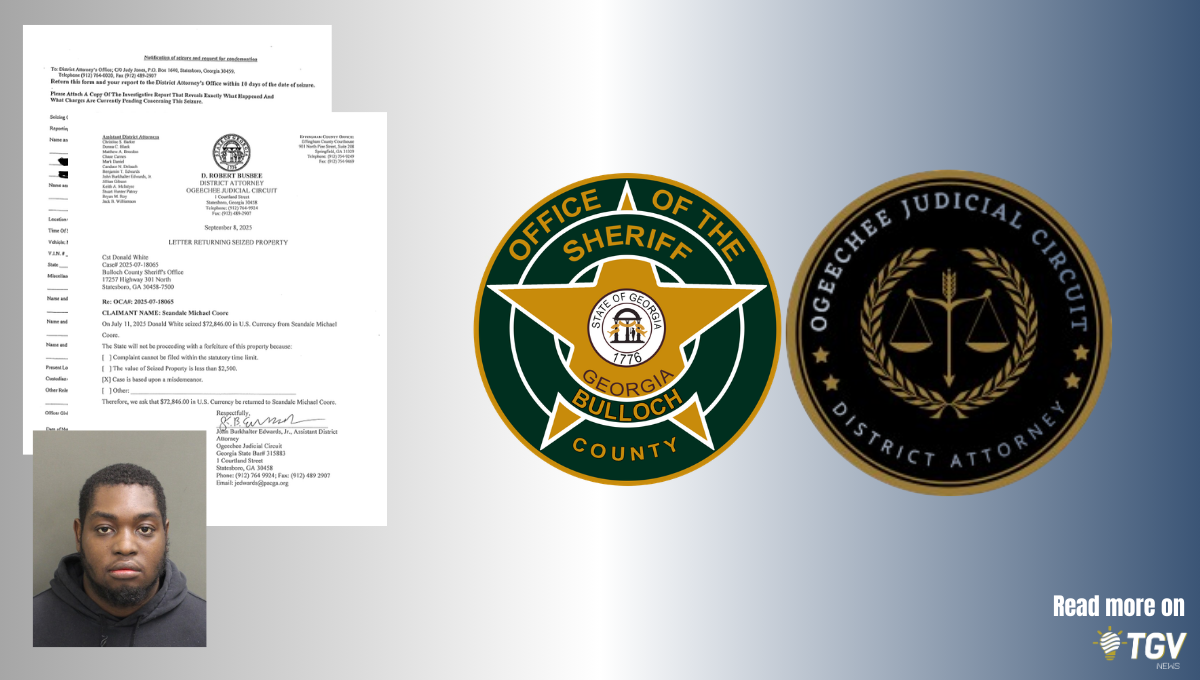
On July 24, 2025, BCSO CST submitted a ‘Notification of seizure and request for condemnation’ for the money seized from Coore. The form included the date of arrest, where the property was located when it was seized, the amount, and where the money is currently placed. The Incident Report for the case was also attached to the notification, indicating the basis of the forfeiture was the misdemeanor drug charges and information discovered during the course of the investigation.
District Attorney’s Office Declines to Proceed with Asset Forfeiture
In a memo dated September 8, 2025 to CST Donald White at the Sheriff’s Office, the District Attorney’s Office indicated the misdemeanor charges as reason for declining to proceed. The memo requests that the Sheriff’s Office return the property.
Emails obtained under the Georgia Open Records Act between the DA’s office and the Sheriff’s Office revealed that on October 17, 2025, District Attorney Robert Busbee told law enforcement officials that his office is relying on Smith v. State, a 2024 Georgia Supreme Court case on asset forfeiture.
The email appears to be a summary of discussions from a meeting with Busbee and all four sheriffs in the circuit:
“Sheriffs posed question: If someone is pulled over with a large amount of cash, and they claim it doesn’t belong to them, can it be forfeited?”
Answer: No. There must be evidence of a criminal enterprise. DA is requiring felony charges.
…
Multiple sheriffs posed question: If we catch someone with a large amount of money but cannot prove any illegal activity, does it have to be returned?
Answer: Yes. You must give it back.
In the interim, the Sheriff’s Office retained the money in a seizure fund at a local bank due to concerns about returning the money to Coore.
The neighboring Middle Judicial Circuit does not have an established policy for asset forfeiture. According to the office, they review each case on a case-by-case basis and determine at the time if they have the resources to allocate to forfeiture.
The Georgia Department of Public Safety, however, has a policy dating back to at least 2019. According to Policy 12.05.3(I)(5),
“Probable cause does not exist in cases where the sole suspicious activity involves a large amount of currency alone, or when the purported owner is unable to produce proof of where they obtained the currency.”
Not Drug Money, Fraud Money
A November 18, 2025 email from Busbee to Sheriff Noel Brown, CST, and Solicitor Catherine Findley, revealed that the money seized from Coore was not linked to drug activity, but was instead stolen in an online scam targeting elderly individuals in Florida.
Busbee told the recipients that DA’s Office Investigator Andre Wright ran Coore’s information through LInX, a secure, NCIS-sponsored, federally funded regional database system allowing local, state, and federal law enforcement to share over 1.5 billion records across jurisdictions, and learned that he was the subject of a statewide investigation in Florida.
“It turns out Mr. Coore and his contacts in Atlanta are not drug dealers. They are online scam artists. The $72k you recovered on July 11th was stolen from an elderly woman in Florida on July 8th. Mr. Coore was also involved in stealing roughly $100k from elderly man in Florida later in August,” Busbee wrote.
TheGeorgiaVirtue inquired as to why the DA’s office continued investigating the matter if the asset forfeiture was declined and the criminal case was in state court. Busbee replied with the following:
This was in response to the October 14, 2025, meeting with the sheriffs and the lieutenant running the Bulloch County Crime Suppression Team. Speaking with the lieutenant, I agreed that Mr. Coore appeared to be a drug mule based on the evidence they had obtained, but as we did not have enough evidence to charge him, I asked if they had shared this information with other agencies. We know he’s driving back and forth between central Florida and North Georgia. I asked if the lieutenant had notified the DEA or GBI or GSP or anyone who could be on the lookout and hopefully catch Mr. Coore with drugs. The lieutenant advised he had not.
When I got back to the office, I spoke with my own Chief Investigator about getting this information to our other law enforcement partners, and he ran Mr. Coore’s name through the national database. It was then that we learned Mr. Coore was a person of interest in two cases of scamming in Florida, including one involving a nearly identical amount of money being taken from an elderly woman three days before his arrest in Bulloch County.
I quickly reached out to the investigator in Florida and shared our information. As a result of the information we shared, arrest warrants were issued in the two cases in which Mr. Coore was a person of interest and another warrant was issued in a case in which they had no suspects.
Investigators from Florida reached out to the Bulloch County Sheriff’s Office and they assisted as they could. Per the request of the Florida agencies, BCSO still has the $72,846, pending final adjudication in the respective criminal cases.
Coore was arrested in Orange County, Florida on February 2.
Two Conflicting Perspectives
Still, the two constitutional offices have very different perspectives on the appropriate course of action in this case.
TheGeorgiaVirtue reached out to the Sheriff’s Office for official comment, but did not receive a response. Those in law enforcement, however, take the position that had the money been returned to Coore after the DA’s Office declined to proceed with forfeiture, it would be in the hands of someone who obtained it unlawfully.
The district attorney disagrees.
“That is an interesting way to frame what happened. We received a request from the Crime Suppression Team to forfeit a huge sum of purported drug money based solely upon a misdemeanor marijuana arrest. My chief investigator picked up that incomplete investigation and learned that it was not drug money, and it belonged to an innocent victim. Had my office simply approved their request in July, the money would not have made its way back to the victim. The BCSO would have kept it,” Busbee said.
Relevant Case Law
$24,500 in U.S. Currency v. State of Georgia – held that the State must show a substantial connection between the property and a specific drug violation. In Coore’s case, the substantial connection would have to be between the misdemeanor amount of marijuana, the rolling papers, and the $72,846 in cash. Without the state proving the money came from illegal activity, the court could reject the money came from illegal activity.
In State v. Jackson, the Georgia Court of Appeals ruled that simply alleging that the property was “used in violation of the drug laws” is insufficient. The case arose out of jointly owned property where one party is involved and one party is not, but it has been cited for years regarding the requirement to state specific facts establishing probable cause.
In the 1996 Thompson v. State case, the Georgia Court of Appeals ruled that the presence of drugs alone does not automatically justify forfeiture of property. The evidence, the court said, supported simple possession, not drug trafficking or distribution.
And in Sims v. State, the courts ruled that there must be evidence that the property facilitated or resulted from the crime.
More recently, in 2024, the Georgia Supreme Court tightened the grip on asset forfeiture practices even more in Smith v. State. Specifically, the ruling said that vague accusations are insufficient and the state is required to plead an actual criminal offense tied to the property.
In the ruling, Justice Colvin wrote that while the allegations in the Smith case “about the purchase and sale of property known to be stolen may create an air of criminality, they fail to allege any facts showing that any person unlawfully took another’s property “with the intention of depriving him of the property,” that being the element of the actual criminal offense. In the Coore case in the context of Smith, the misdemeanor charges may not meet the standard to show how the money was connected to the criminal act. Whether charges like that do, however, could be determined by a judge.