Georgia lawmakers voted Thursday to approve a measure which defines the male and female sex under Georgia law, strictly limits use of restrooms and changing areas in public schools and colleges, and regulates athletics at public institutions.
But the 25-page bill has a number of nuances, so here we break it down section by section.
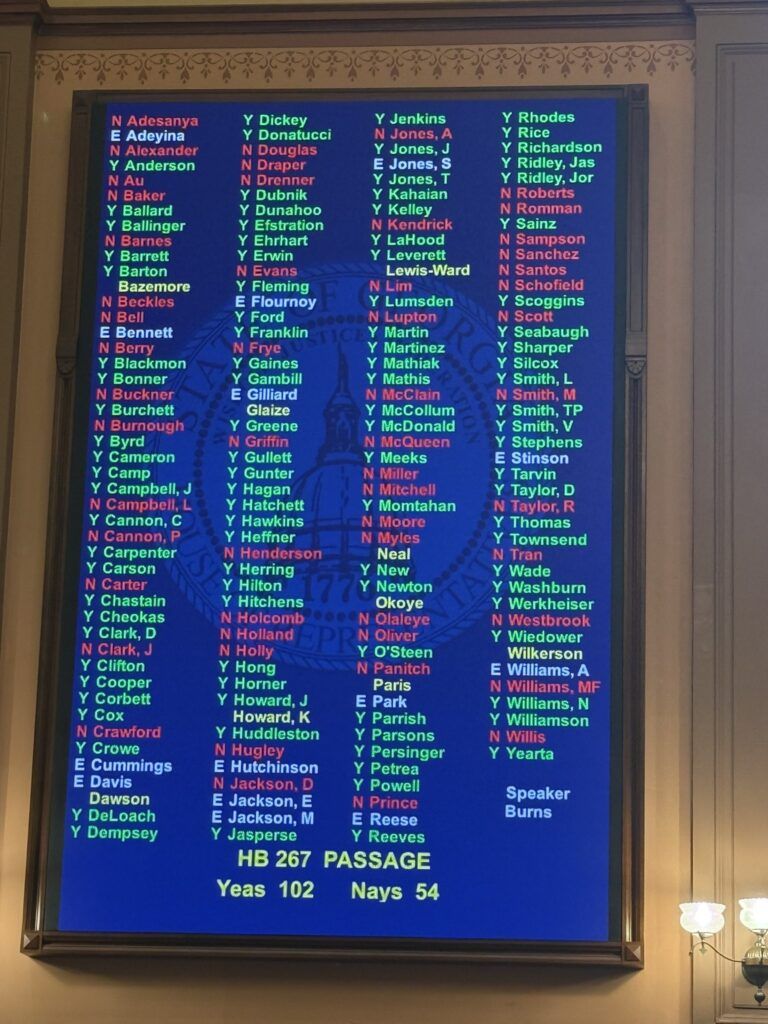
House Bill 267 is sponsored by State Representatives Josh Bonner, Jan Jones, Will Wade, Ginny Ehrhart, Sandy Donatucci, and Todd Jones. It passed out of the House Education committee on February 24 and the House Rules committee on February 26. It passed out of the Georgia House by a vote of 102-54 on Thursday.
The bill does the following:
- Creates the Riley Gaines Act via a new code section: OCGA 20-2-771.3
- Defines athletic event, female, male, multiple occupancy restroom or changing area, and sex (in biological context of male or female)
- Male defined as an individual who has, had, or will have a reproductive system capable of generation, migration, and utilization of sperm for fertilization or would have such capabilities but for a developmental or genetic anomaly or historical accident
- Female defined as an individual who has, had, or will have the reproductive system capable of generation, migration, and utilization of eggs for fertilization or would have such capabilities but for a developmental or genetic anomaly or historical accident
Public Schools
- “To ensure privacy and safety of students in public schools,” public schools are required to:
- designate areas for exclusive use by each respective sex – restrooms, locker rooms, changing rooms, and shower rooms.
- provide reasonable accommodations to individuals who are unwilling or unable to use multi-occupancy restrooms or changing areas for each respective sex
- by giving them a single-occupancy restroom or changing area
- does not mean the school must allow a person of one sex to use an area designated for another sex while other individuals of opposite sex are present
- There outlined exclusions on sexes entering opposite sex areas/restrooms for custodial/maintenance work, emergency medical assistance, to address an ongoing emergency (including a physical altercation), a minor child accompanied by a parent/legal guardian, performance of official duties by coaches and trainers
- Leaves room for local school systems to adopt policies to comply with federal ADA while still adhering to this state measure
- Requires school systems to ensure public school students on overnight trips share sleeping quarters with members of the same sex or are provided single-occupancy sleeping quarters, unless the member of the opposite sex is a member of the student’s immediate family
- Gives Professional Standards Commission the authority to investigate complaints alleging noncompliance and issue sanctions against public school employees/agents
- Gives parent/legal guardian cause of action against a public school if a student:
- Encounters a member of the opposite sex in a multiple occupancy restroom or changing area designated for individuals whose sex is the same as the student AND the student of the opposite sex was given permission by an official, employee, or agent of the local school system
- Basically means a parent can take action if a school system employee is given authority to opposite sex student to use the other restroom/changing area
- Is required by an official/employee/agent to share sleeping quarters with a member of the opposite sex
- Encounters a member of the opposite sex in a multiple occupancy restroom or changing area designated for individuals whose sex is the same as the student AND the student of the opposite sex was given permission by an official, employee, or agent of the local school system
- Gives the State Board of Education the authority to regulate this with rules and policies
Colleges, Universities, and Technical Schools
- All of the above applies to colleges and universities/tech schools as well, but authority to regulate and issue rules is given to the Board of Regents and Tech. College System of Georgia
Athletics
- Requires public schools, school systems, and post-secondary education institutions to offer equal athletic opportunities for members of both sexes, though ‘opportunities’ is not defined
- Adds OCGA 20-1-52 to allow a school or college to have single-sex teams based on competitive skill or based on whether or not the activity is a contact sport
- Requires schools/colleges to designate athletic events as for males, for females, co-ed
- Bars public schools playing other public schools (or public college vs another public college) for an athletic event or competition from allowing any male to compete with a team designated for females
- Males cannot have a roster spot or receive scholarship funds intended for females
- Requires birth certificate sex to be the determining factor and explicitly bars any public institution from ‘inspecting’ external sex organs for participation
- Inspection of medical records is permissible
- Males and females can practice together as long as it’s informal and does not impact roster spots or funding
- Prohibits government entities and licensing boards from taking adverse action against a local school system or public school for complying with this state law
- Recourse for noncompliance of this code section:
- Allows private course of action if deprived of athletic opportunity under this code section, to include injunctive relief and compensatory damages.
- Also provides a course of action for individuals and teams subjected to retaliation or adverse action as a result of reporting a violation of the statute to an employee or representative of a local school system, a public school, athletic association, or post-secondary education system
- Actions regarding adverse action seeking damages must be brought within one year of the event giving rise to the complaint.
Amendment to OCGA 1-2-7.1 relating to persons and their rights
- General Assembly defines sex and writes that the term ‘equal’ does not mean ‘the same’
- Guarantees that an individual born with a medically verifiable diagnosis of disorder or differences in sex development is afforded legal protections and accommodations afforded under the Americans with Disabilities Act of 1990
- Reiterates that laws, rules, and regulations that distinguish between the sexes are subject to ‘intermediate constitutional scrutiny’ which forbids unfair discrimination against similarly situated male and female individuals but allows the law to distinguish between the sexes where distinctions are substantially related to the important governmental objections.’
- Requires school systems, state agencies, etc that collect data for vital statistics do so by indicating male or female based on assignment at birth
- Goes on to define sexes for other uses by the state/state agencies by:
- Explicitly define lining Father as parent of the male sex
- Male defined as an individual who has, had, or will have a reproductive system capable of generation, migration, and utilization of sperm for fertilization or would have such capabilities but for a developmental or genetic anomaly or historical accident
- Explicitly defines Mother as parent of the female sex
- Female defined as an individual who has, had, or will have the reproductive system capable of generation, migration, and utilization of eggs for fertilization or would have such capabilities but for a developmental or genetic anomaly or historical accident
- Woman means a human female
- Man means adult human male, except when used in generic reference to human rights
- Explicitly define lining Father as parent of the male sex
- Otherwise replaces references to ‘gender’ to ‘sex’ so as to align with the definitions outlined in the OCGA 1-2-7.1
Read the most recent version of the bill here.
With the passage of the bill by the Georgia House, the measure now heads to the Senate. There, it will again have to go through the committee process, the Senate Rules committee, and a full vote on the Senate floor. If any changes are made, lawmakers in the House will have to agree to the changes with another floor vote before Day 40 of the legislative session, which is April 4.
VOTE:
Reps. Debra Bazemore, Robert Dawson, Lydia Glaize, Regina Lewis-Ward, Neal, Gabe Okoye, Miriam Paris, and David Wilkerson were present, but did not cast a vote.