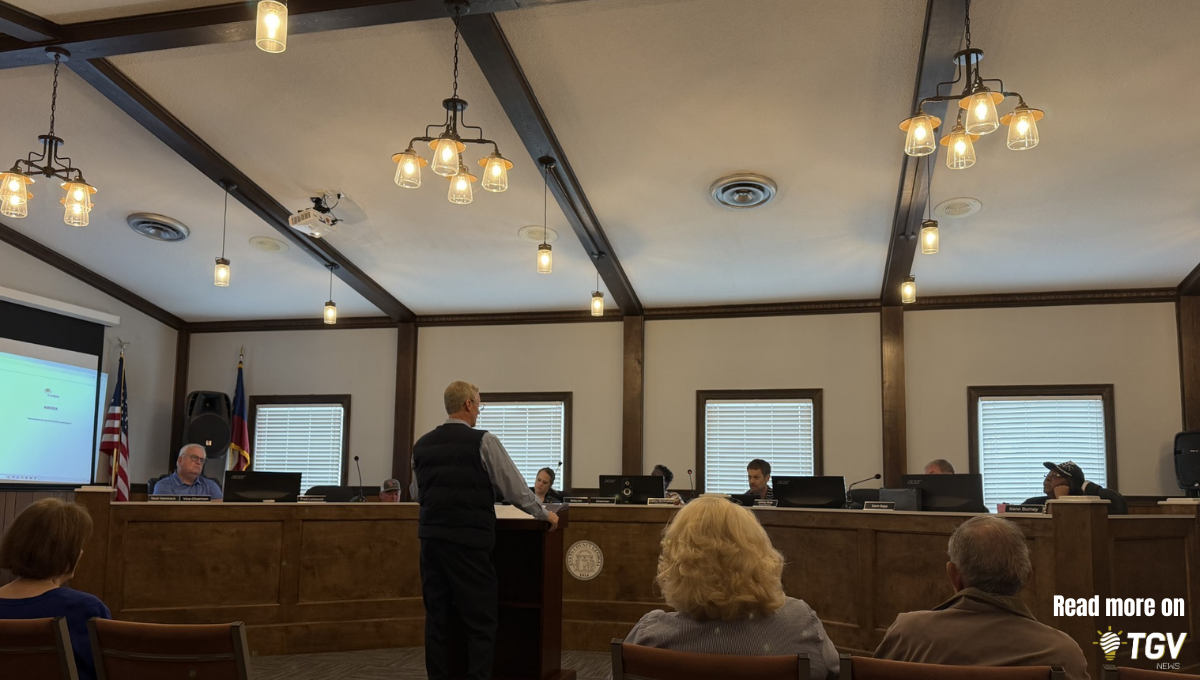
Commissioner Pratt Lockwood and County Attorney Johnny Vines were not present for Thursday’s workshop. Representatives from the City of Hagan were present, but did not participate in the discussion.
A representative from the Association of County Commissions of Georgia attended a workshop with Evans County Commissioners last week for an informal dialogue on the pros and cons of city-county consolidation.
Executive Director of ACCG Dave Wills visited Evans County Thursday for a workshop with county elected officials who wanted to know more about the consolidation process. Citing concerns over ever-increasing costs and public outcry over taxes, officials voted recently to explore options and pathways to consolidating city and county governments within Evans County.
Commissioner Tony Lewis said taxpayers have implored them to do something, but they want to know what the process entails.
“Inflation, fuel, costs of equipment, cost of the people running it…We had a study in 2017 and it kind of said it would be probably a good thing, but it kind of got mashed down. So we asked Casey to bring back another presentation to show us what it would save. What he presented to us was a savings and we felt like it was our duty to send it to the citizens to see what they want,” Lewis said.
Wills told commissioners he was there “to educate, not promote” consolidation. His presentation was, at times, confusing due to the informality of the discussion and the lack of structure to provide a timeline or pathway for the process, but before fielding questions from commissioners, he presented his own familiarity with the process.
Wills led the consolidation of his own county government in Webster County in the early 2000s. Webster County now has a population of roughly 2,700 and in the case of his consolidation, the cities dissolved to combine. Dissolution of cities is not required, nor is it the norm, as evidenced by Macon-Bibb County, Augusta-Richmond County, and Columbus-Muscogee County governments. The process in Webster began in 2007 with a study, followed by a referendum before voters, and took effect in 2009.
Four Different Methods to Consolidate
Wills told commissioners there are three or four different methods to consolidate. He said his personal recommendation was based on politics.
Consolidation requires a local Act through the legislature in order for the matter to be placed on the ballot for voters. Wills said he recommends having a local Act passed by lawmakers before conducting a study on consolidation. Each local government would approve a resolution requesting state lawmakers who represent Evans County to introduce an Act in the General Assembly. Evans County is represented by State Representative Bill Werkheiser in the Georgia House and Senator Billy Hickman in the Georgia Senate.
Wills said getting the local Act approved before a study is done is his recommendation because people are better about ‘agreeing to a study’ as opposed to having a study done and then deciding whether or not they agree with it. Essentially, the matter could be placed on the ballot after the study because it would not have to go back before the legislature.
The local Act would create a commission to study the consolidation and after 12-18 months of work, the commission would make recommendations about whether or not consolidation is in the best interest of the county and should be placed on the ballot for voters.
Wills did not offer any explanation about any other pathways to consolidation.
Study Commission
A study commission could be created however elected officials see fit, but Wills made recommendations as to the makeup of the commission based on a weighted population.
He said based on the county population of 10,900, approximately 2,500 in Claxton, 950 in Hagan, and 100-150 each in Bellville and Daisy,
- County – 5 representatives
- Claxton – 1 representative
- Hagan, Bellville, and Daisy – 1 representative for all three
Wills said in Webster county, no sitting elected official served on the study commission – it was all done by citizens of the county – but his county did not have a county administrator, so he provided all the paperwork and reports on which the commission made their recommendations. He also said the Webster County consolidation study committee appointed two additional members once they convened for a total of nine members.
The study commission will have the ability to recommend functional consolidation, meaning more intergovernmental agreements and shared services, as opposed to full consolidation as well.
Will Consolidation Drive Down Costs?
Wills said hypothetically costs would go down due to shared services, shared equipment, and the like, but it does not mean costs will never go up. The goal would be to slow the rate the costs are increasing.
“When they study this, they will do a cost analysis, but hypothetically if costs are going up, it doesn’t mean costs will immediately come down, they may stay flat and will slow the increase,” Wills told commissioners.
Wills also shared that unified governments expand how and when local governments can collect franchise fees. As it currently stands, only cities can collect franchise fees, with the exception of cable TV, which is essentially obsolete.
The county cannot collect franchise fees on large load customers, but if the county and cities consolidated, the franchise fees could be assessed on large load customers of electric service providers like the cold storage facility and Claxton Poultry. In Webster County’s example, they were able to roll back county property taxes by one half of a mill. County Administrator Casey Burkhalter said for Evans County, that could mean one-and-a-half mills.
Some things that would not be consolidated would be things like bonded debt held by a city at the time of consolidation. Wills said a special service district would be created to offset the debt to ensure the county taxpayers, who did not take out the debt, aren’t left on the hook. For example, if a city has $1 million in debt, a special service district would be created to assess a fee to those within the municipality until the completion of the debt.
Can Consolidation Be Forced?
Wills told commissioners that consolidation is not the merging of government, but the abolition of the regular government and the creation of a new government.
- City-County consolidation cannot occur without the consent of the public, meaning it must be voted on by voters
- Residents within the city limits would actually cast two ballots. First, in their capacity as a city resident and then in their capacity as a resident of the county.
- If a city has less than 10% of the county’s total population, which in Evans County would include Hagan, Bellville, and Daisy, those cities could not act as a ‘veto’ on the process once it gets to a referendum. For example, if a majority of residents in the county approve consolidation and voters in Claxton approve consolidation but any or all of the three smaller cities do not, the cities where the consolidation was not approved would remain independent.
- He said this happened with Payne City in Macon-Bibb, but the city changed course after consolidation and a changing landscape, later asking to be absorbed by the consolidated government by rescinding its city charter.
- In Augusta-Richmond County and Athens-Clarke County, there are smaller jurisdictions that refused to join the unified government.
- Cities do not have to dissolve entirely and rescind their charter in order to consolidate.
- There are 8 consolidated governments in Georgia, more than any other state in the nation.
- No consolidation has ever been ‘undone’ after the fact.
Questions from County Commissioners and Staff
County Administrator Casey Burkhalter asked Wills if he had ever seen a consolidation with the county and municipalities with the exception of the county seat (Claxton). Wills stated he had not seen such an instance.
Commissioner Neal Hammack also asked if consolidation would mean the city police and the Sheriff’s Office would combine and become one. Wills did not address the question directly, but constitutional offices would not be ‘consolidated’ with other entities in the same way a city and county fire department would consolidate. “We’re certainly going to have a sheriff,” he said. “But would you have a police department? That’s something for the study commission,” Wills said.
Commissioner Tony Lewis asked if the county would still have to give cities money if they don’t agree to be a part of the consolidated government. Wills said the county would still be legally obligated to divvy up SPLOST, LOST, and other similar funds.
Time is Of the Essence
“I wouldn’t delay,” Wills told commissioners. He said the legislative session for the year is already underway and between the local resolutions, public advertising in the legal organ, and the work that needs to be done in the legislature, the local Act needs to be addressed quickly in order to be approved this year.