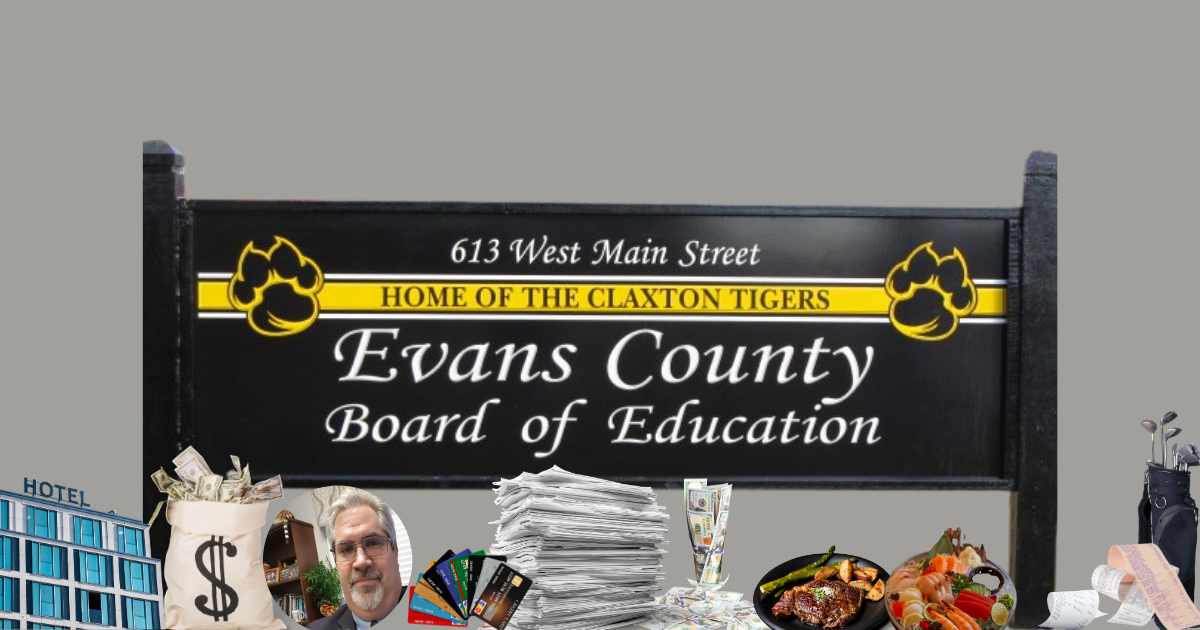
Evans County School Board members heard from an independent auditor Monday night who presented a harrowing picture of the financial practices of the previous administration, many of which the Board may be cited for in the upcoming state audit.
Caroline James, who spent thirty years working for the Georgia Department of Audits and Accounts (DOAA), offered insight into her examination of the school system financials for FY 2025, which ended June 30, 2025. Her review, which was initially expected to take roughly two months, amounted to four months of reviewing bank statements, personnel records, and other receipts and other documentations while interviewing accounting department employees, assistant superintendents, and even previously employed CFOs. She also compared the issues to those brought to light in the FY2024 audit to see if a pattern of issues existed.
It is important to note that these items are for FY 2025, so they have not yet been reviewed by the state auditors and are separate from the issues brought to light by the FY 2024 audit back in May. Interim Superintendent Brad Anderson recruited James to assist in an internal audit of the financials to be approved by state auditors later this year so that 1. The Board would preemptively be aware of what issues are expected to be noted in the upcoming audit, and 2. To ensure corrective action is already underway as the Board is currently in FY 2026. The school system will be subject to additional scrutiny by the DOAA because of the issues noted in the FY 2024 audit.
Since the hiring of Anderson, many of these issues have been resolved and the remaining identified issues are in process for correction with the help of contracted auditors and the new CFO hire of Anthony Parrillo.
Issues Discovered During Internal Financial Review
Superintendent Advanced Annual Leave – Former Superintendent Marty Waters was advanced 25 days of annual leave in July 2024 before it was earned. He then requested payout for those annual leave days (7 days in 2024, 10 days in November 2024, and 8 days in March 2025. He did not earn the full 12 months of leave and was overpaid 2.08 days in the amount of $1,215.61.
Changes to Assistant Superintendent Position Without Board Approval – Assistant Superintendent Dr. Robert Costlow was overpaid $5,184.48 in FY 2025 and $6,672 in FY 2024 in compensation not permitted under policy and where no documentation of Board approval exists.
- James also said she could not find any documentation of Board approval for the move from the position of Director to Assistant Superintendent or documentation that supported moving the position from 230 days to 240 days, which impacts the earned annual leave for the employee.
- There was a $3,500 Athletic Supplement with no Board approval.
A 49% Employee Earned Annual Leave During FY 2025 at a rate of 64.6% – Part-time employees are not eligible to earn annual leave – it is expressly prohibited by the state. The employee, Dr. Toney Jordan, resigned during FY 2025 and was paid out for his annual leave causing an overpayment of $1,672.10. The employee was also awarded 159.548 hours in Exchange Leave for the sick leave that he was unable to obtain creditable service credit when he retired in June 2024. He used this leave when he was employed during FY 2025, therefore he received payment for days not earned. James said the total amount of overpayment was actually more than what her presentation reflected.
Untrackable Pay Supplements – A complete list of supplements was not presented to the Board, therefore, the Board did not approve the supplements that were being paid to various employees. The supplements were put in the annual budget but never attached to a specific employee or a specific position, so Board members (or anyone else) could not compare the salaries year-over-year, or even see a total amount of each employee.
No Due Diligence Review Over School Activity Accounts – These accounts are required by law to be reviewed annually, but must also be reviewed by the superintendent on a quarterly basis. This was not happening.
Circumvention of Purchase Order Process by Superintendent Waters – Superintendent Marty Waters utilized a manual purchase order process outside of the school district’s financial management system for credit card purchases, circumventing required purchasing procedures, and approval controls.
Travel Reimbursements did not follow state travel policy – Superintendent Marty Waters authorized and expended $1,085 on meals for himself and other administrators while on travel status. These expenses exceeded the state’s per diem meal allowance and were not processed through the standard travel reimbursement procedures. There is no documentation regarding who was at this meal.
Hotel Bookings Violated State Travel Policy – Hotel rooms were booked before the actual stay, which is a violation of the state travel policy. Two instances were noted where Superintendent Marty Waters had a room reserved but did not attend the conference/meeting and failed to cancel the room.
Golf Activities – Superintendent Marty Waters, with involvement from three other members of management, authorized $300 for golf-related activities. These expenses were not supported by documentation, demonstrating a clear and necessary business purpose, in violation of School District Policy.
Travel Expenses in City of Residence – One administrator, Dr. Toney Jordan, claimed $1,032.55 for travel within the same city of his residence, which is in violation of the State Travel Policy. The hotel fee included state and city taxes, which should have been exempt if proper forms were provided to the hotel.
Travel Reimbursements Not in Accordance with State Policy due to a ‘formula error in the travel reimbursement form.’
Public School Employee Retirement System (PSERS) Compensated Absence Policy/Procedure – This is not currently included in the school system policies. The wording in the Employee Handbook was changed at some point, which does not represent the procedures being followed by the payroll clerk at the end of the fiscal year.
Flawed credit card policies – The credit card policy in place does not match state requirements and was not being followed. Interim Superintendent Brad Anderson has eliminated all credit cards and said eventually there will only be one credit card that is used for the entire district. It will be kept in the possession of the CFO with strict oversight. Anderson said a credit card will not be obtained for the district until a sound policy is in place and approved by the Board.
Impermissible debit card policy – The current credit card policy mentions a debit card, which is strictly prohibited under state accounting policies due to the lack of controls that come with a credit card.
Misuse of State Funds
- Uniforms (band, sporting, etc) were purchased with state QBE funds, not local dollars. QBE funds are for things where students earn a grade.
- Employees used the credit card for purchases that are against the school district policy. These purchases were for association fees, Sam’s Club memberships, etc. The payments were made with state QBE funds, which is prohibited.
Purchase of unallowable items – Flowers, snacks, meals, rewards for students were purchased with the credit card and without going through the proper procedures.
Bids or Quotes were not being used as required by policies and procedures – The Statesboro Winletric Co invoice for $38,902.50 was not bid.
Policies have been in ‘DRAFT’ status for a considerable length of time. Policy revisions were not made in a timely manner and remained in ‘draft’ status for a long period.
Documentation issues with hiring – James said the Central Office should keep a record of documenting prior experience, current pay rates, a current job description, and the pay schedule when someone is hired.
Personnel Handbook is stored on Google Drive and can be updated ‘at will.’ – No official copy is maintained to show what changes the board approved and changes were not detailed in the Board Minutes. There was conflicting information between the policies and the personnel handbook as it pertains to Leave Accruals and PSERS sick leave payout.
Master Salary Schedule on a Google Document and can be edited at any moment – James said an official master copy, which is printed, needs to be maintained by the Payroll Clerk once it has been Board approved. The Board was not approving the Salary Schedule on an annual basis.
Board Meeting Minutes need to be more detailed – James told the Board that the meeting minutes should be detailed to include information about what happened at a meeting, what was discussed, and how the vote was decided. If it pertains to bids and other procurements, who was outbid and at what amounts should also be included.
SPLOST Spending Issues – Working being completed on the same project is recorded as Local Capital Projects for SPLOST Projects. There is little consistency of how the projects are coded.
Claxton Elementary School
- New stage flooring was invoiced from Lynn Construction as an additional charge, not a change order, even though they were performing contract work on CES at the time. This should have been a change order. This process is not in accordance with policy.
- Stage front expenditures of $39,695 were ordered directly from the vendor, outside of Lynn Construction constant. No bid was obtained.
- Original Proposal that was not approved by board was for $599,488. The project was reduced to $438,030. Stage flooring was removed from the project. Superintendent Marty Waters authorized the state expenditures to be purchased and completed outside of the contract.
- James said Lynn Construction does not always use the Retainage Payable for ongoing projects or the standard form used across the state. This provides a line item accounting of the project cost, change orders to date, and what work has been done with a Retainage Payable line item to ensure the project is finished to completion. It’s also required by state DOAA, which means the school system has not been in compliance.
Arts & Cultural Authority-Leased Building (2-story building)
- No construction contract between the school district and Lynn Construction or Arts & Cultural Authority (ACA). The construction contract is between Lynn Construction and the ACA. The lease is between the ACA and the school district, at a rate of $1 per year, and notes that the ACA is responsible for all renovations made to the 2-story building.
- Payment for the 2-story building has been charged to various accounts over the past 3 years.
- Lynn Construction added a $88,300 change on application for payment #7 (May 2025). No documentation was provided for this change order when it was added to the invoice.
- Lynn Construction’s Payment Applications did not include Retainage Payables during the process. The board paid 100% of the amount claimed on the invoice as work completed. No Architect approval of work completed. Supt provided approval to pay.
General Accounting Issues – Assets purchased during the year were not added to the capital asset fund when purchased. The CFO had to manually review purchases and add before closing the ledger at year end. The ERP system has a process that can help track purchases and should be utilized in the future.
Beginning balances do not equal the audit balances.
Conclusion
“The issues noted in the FY 2024 were still happening in FY 2025 due to management override and failure to follow established internal controls/policies/procedures.”
James told the Board that she anticipates the audit having the same issues as the previous year, many of which may be more extensive, with notations that a number of the issues have since been resolved.
At the end of the presentation, Dr. Anderson asked if Board members had any questions.
None were asked but BOE member Joyce Lockwood remarked, “I’m amazed.”