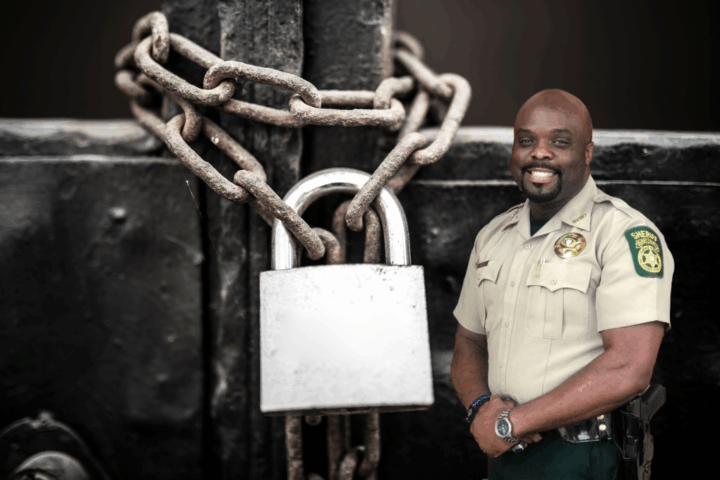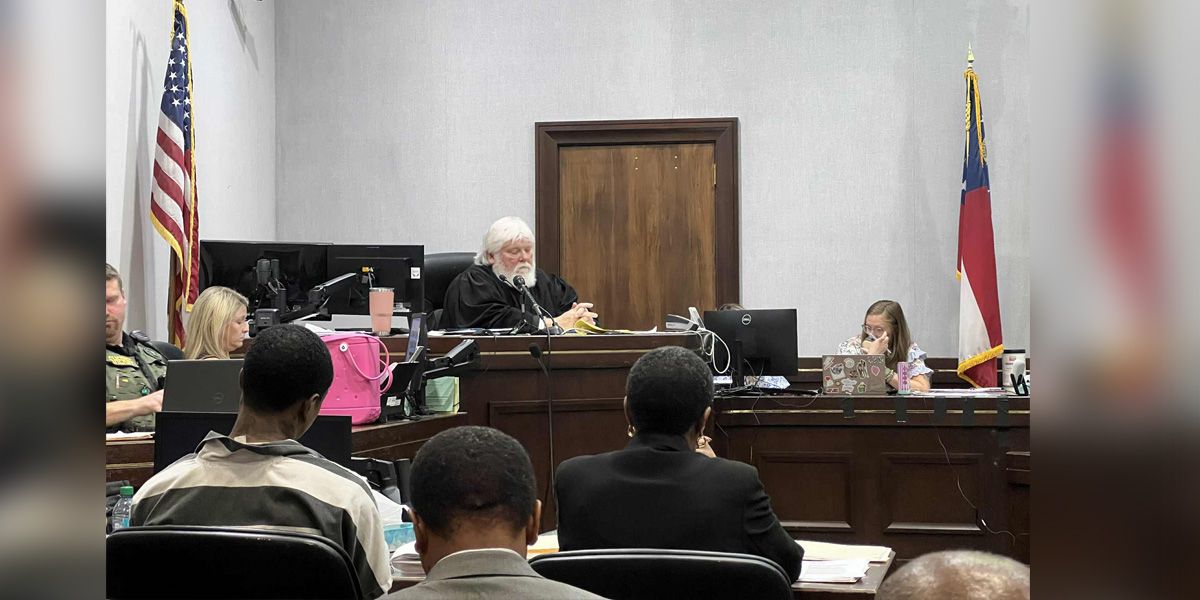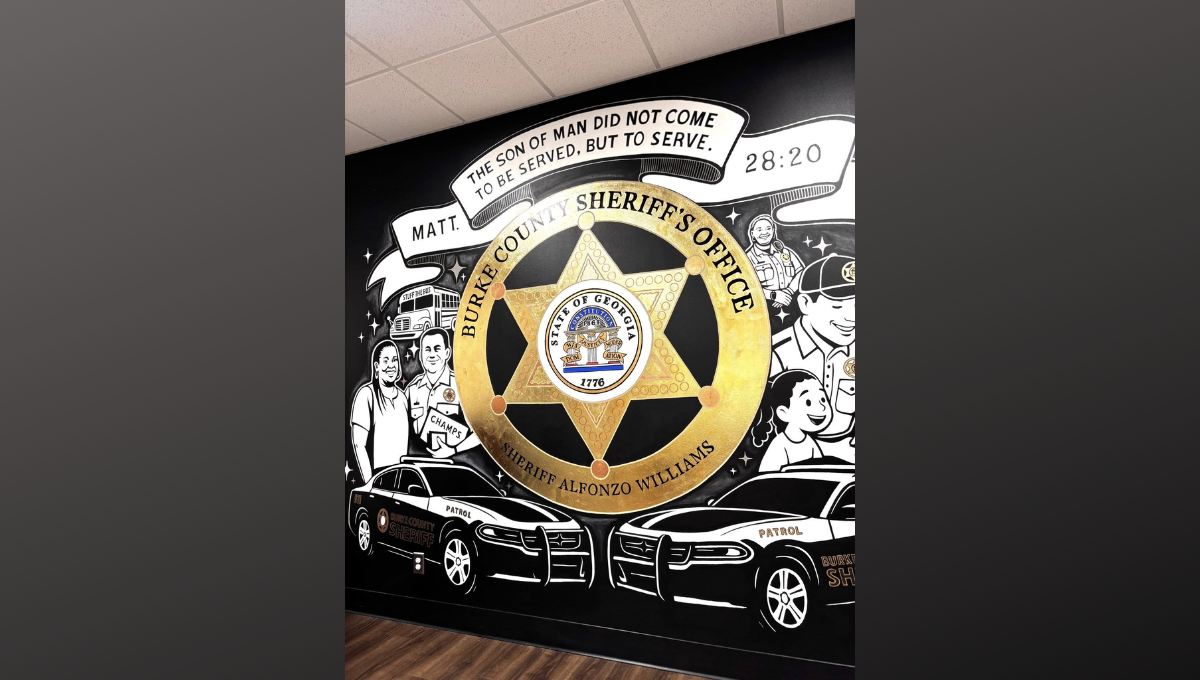
Just weeks after filing a lawsuit contending that the county commissioners are not providing the Burke County Sheriff’s Office with sufficient funds to fulfill its constitutional duties, Sheriff Alfonzo Williams unveiled a taxpayer-funded mural at the office, depicting his name and a misquoted verse from the Bible.
The mural, which displays the Burke County Sheriff’s Office badge, patrol cars, and members of the community, also includes a quote from the Bible:
“The Son of Man did not come to be served, but to serve.” – Matt 28:20
But that Bible verse is actually found in Matthew 20:28. Matthew 28:20 references Jesus’ instructions to his followers to “make disciples of all nations, baptizing them in the name of the Father and of the Son and of the Holy Spirit, and teaching them to obey everything I have commanded you.”
The painting cost totaled $2,840, according to county records.
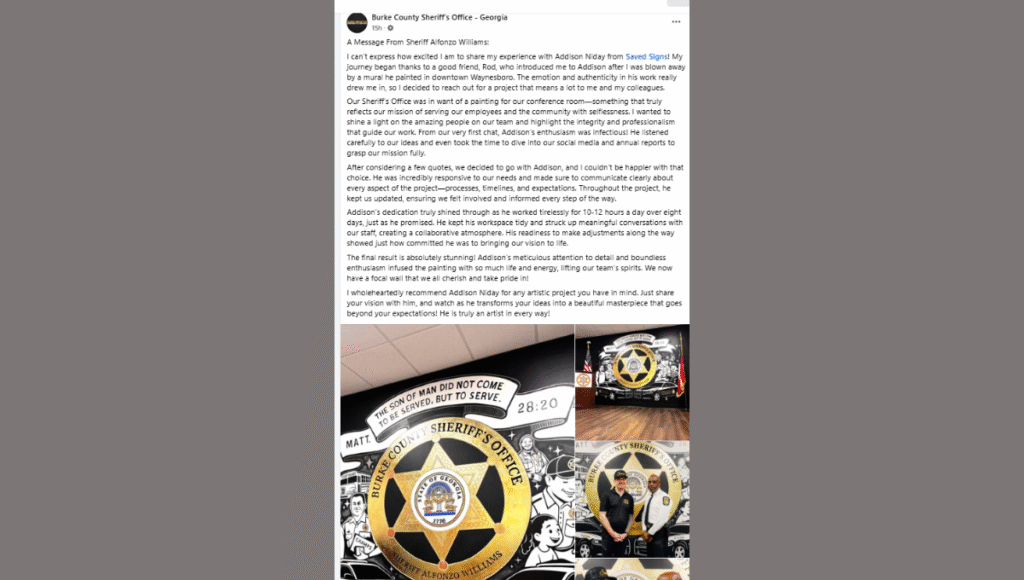
Williams took to the official Facebook page for the office Thursday to announce the mural, noting that it displays ‘selflessness.’
Can a Bible verse be displayed in a taxpayer funded building?
In determining whether or not a display of religious texts in government buildings is acceptable, the courts have repeatedly looked to the Lemon test, stemming from a 1971 U.S. Supreme Court case (Lemon v. Kurtzman). The Lemon test considers context, location, and the overall message, specifically:
Secular legislative purposes
Primary effect that neither advances nor inhibits religion
No excessive government entanglement with religion
In 2021, the Freedom From Religion Foundation (FFRF) challenged a Sheriff in North Carolina for displaying Philippians 4:13 in the Sheriff’s Office building. “A blatantly Christian message in a law enforcement division sends a message of exclusion,” the organization said. The Sheriff responded by saying it was one of his favorite verses and seemed fitting for “the adversity he had to endure.” In that case, the quote was paid for with private funds.
The FFRF wrote that “federal courts have upheld restrictions on the display of religious materials by government employees on government property because such restrictions exist to avoid Establishment Clause violations. The 9th U.S. Circuit Court of Appeals has stated that the “government has a greater interest in controlling what materials are posted on its property than it does in controlling the speech of the people who work for it.”
In 2024, the FFRF challenged the display of Matthew 5:9 on the website of a Tennessee Sheriff and the verse was subsequently removed.
Other notable U.S. Supreme Court cases:
Stone v. Graham (1980): Displaying the Ten Commandments in Kentucky public school classrooms was ruled unconstitutional as it lacked a secular purpose and endorsed religion.
Lynch v. Donnelly (1984): A city’s Christmas display including a nativity scene alongside secular symbols was upheld, as it was seen as having a secular purpose and not primarily promoting religion.
County of Allegheny v. American Civil Liberties Union (1989): A nativity scene displayed alone in a courthouse was found to violate the Establishment Clause, indicating an endorsement of religion, while an external display with a menorah and Christmas tree was permissible due to the context.
McCreary County v. American Civil Liberties Union (2005): Prominently displayed Ten Commandments in two Kentucky courthouses were unconstitutional due to a religious purpose.
Van Orden v. Perry (2005): A Ten Commandments monument on the Texas State Capitol grounds was deemed constitutional as it served a predominantly non-religious purpose within the context of other historical markers.