An inmate facing the death penalty for a botched murder-for-hire prosecutors allege he orchestrated from Smith State Prison obtained protected documents he was not permitted to possess without an attorney present and shared them with other inmates in the prison system.
The issue arose in the case of Nathan Weekes in Tattnall County, where he is facing murder charges for the 2021 killing of Bobby Kicklighter.
The concern over protected case documents resulted in the request for an emergency hearing and a search warrant executed by the GBI at the Special Management Unit at Georgia Diagnostic & Classification Prison.
Timeline
Prosecutors filed paperwork ahead of the hearing outlining the timeline:
April 25, 2022 – Weekes and several co-defendants were formally indicted in Tattnall County on charges related to the January 30, 2021 murder of Bobby Kicklighter. In August, the state announced its intention to seek the death penalty.
October 5, 2022 – Judge Jay Stewart signed a protective order between prosecutors and defense attorneys (Jimmy Berry and Jerry Word), restricting how Weekes could review discovery. Specifically, the order said copies of the actual discovery could not be provided to any unattended inmate.
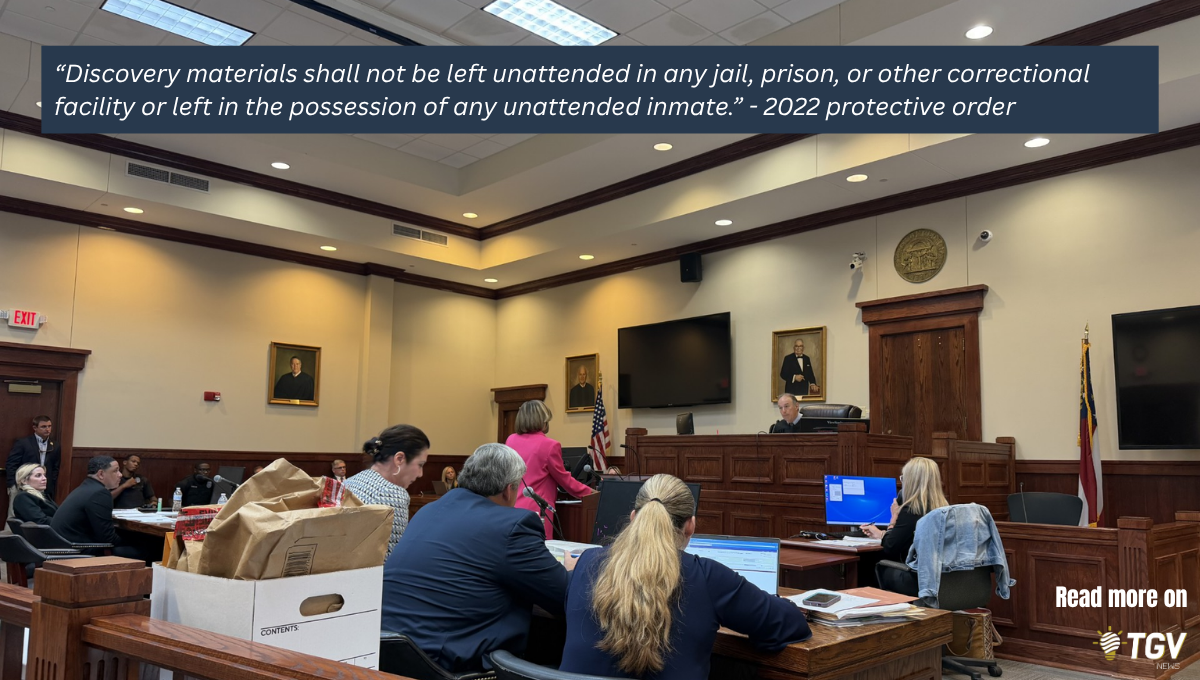
“Discovery materials shall not be left unattended in any jail, prison, or other correctional facility or left in the possession of any unattended inmate.” – excerpt from protective order
June 30, 2023 – New attorneys for Weekes (Christian Lamar and Shayla Galloway of the Capital Defender’s Office) signed the consent protective order for Weekes discovery.
November 17, 2025 – After claims of technological issues, the state recopied all discovery in the case for Weekes’ attorneys. Materials provided included, in part: GBI investigative case files regarding the murders of Bobby Kicklighter, Jerry Lee Davis, and Jessica Gerling; crime lab reports; FBI reports; witness information and interviews; cellular telephone extractions; cell phone records; financial records and reports; audio files; and video files…That hard drive and certification were given to Inv. Gloria Carey with the Capital Defenders Office on November 17, 2025.”
March 10, 2026 – Weekes and his defense team appeared in Tattnall County Superior Court.
March 13, 2026 – At 8:00 p.m., the GBI notified prosecutors that a paper copy of a GBI investigative witness interview summary from the Bobby Kicklighter case file was located inside the cell of an inmate housed at the Special Management Unit (SMU) where Weekes is also housed.
The inmate in possession of the document (Inmate A) at SMU is not connected to the case.
The inmate named in the document (Inmate B) is also an inmate at SMU.
The document had handwriting in the margins which has since been identified by the FBI as that of Nathan Weekes.
“Investigation has revealed that Nathan Weekes gave that document to other inmates inside SMU to intimidate and harass the witness [Inmate B] named in the summary…That witness/inmate notified the GBI that Nathan Weekes has threatened him because of his interview with the GBI.”
March 16, 2026 – Prosecutors notified the defense of a potential violation of the protective order and requested an immediate hearing. Defense counsel objected because one of the two defense attorneys was out of town. A hearing was subsequently scheduled for April 22.
March 26, 2026 – GBI Agents execute a search warrant on the prison cell of Nathan Weekes at SMU. Multiple documents covered by the protective order were seized including summaries of GBI interviews with witnesses from both the Kicklighter and Davis case, as well as documents related to the case from the FBI and GBI financial crimes unit.
April 22 Hearing
On Wednesday, prosecutors reiterated what was outlined in the court filings on the alleged violations Special Prosecutor Sheila Ross told the court that the reason the protective order was signed in 2022 and 2023 was because the number one priority in the case was to protect the victims and the witnesses. The documents recovered from Weekes’ cell had no redactions and included names, addresses, and other sensitive information the state did not want circulating around the prison system.
“We got that order and everyone agreed for the sole purpose of that. Not to be difficult, not to be ornery,” she said.
Ross said the state mitigated the issue by confiscating all of the documents. Privileged information was reviewed in camera by the court and returned to defense counsel. Documents unrelated to the discovery which belonged to Weekes were returned to GDC for the state agency to return in accordance with their policies.
“This can never happen again. We need to know how it happened and we need a trial date. We want to try this case,” Ross told the court. “The quicker we get this tried, the less we have to worry about this happening again. What can’t happen again is this floating around the prison system. It just can’t happen again.”
Ross also shared that the families of the victim in the case had been notified of the issue and were “not happy” about it. “They want to know how this happened.”
Lead defense counsel Shayla Galloway made no attempts to excuse what had happened.
“Not only in the interest of time, but to be transparent and cut across the field, we apologize. The state is wondering what happened and if I’m being completely honest, I’m not quite sure but what I do know is that standing before you, I’m lead counsel and I have responsibility for everything that goes well and when things do not. There was clearly a misstep here,” she told the court.
Galloway also stated that her practice going forward, when taking the lead on a case, will include ensuring that everyone is apprised of court directives, including non-lawyer staff within the Capital Defenders office. Galloway took the lead on the case in January of this year following the retirement of Christian Lamar.
“Excuses are tools of the incompetent so I’m not going to make any but going forward, we will ensure that we are in compliance with what the court has instructed us to do,” Galloway continued.
Judge Stewart said he appreciated Galloway’s apology, but an apology without explaining what happened ignores why everyone was present in court.
Galloway replied that the practice of the office is to give a defendant a few hundred pages at a time to review because the nature of the cases leaves them voluminous in paper. The Weekes discovery, she said, is some 13,000 pages before considering actual media files.
Ross pushed back on the suggestion that it may have been another attorney prior to them taking on the case because the document recovered by the inmate with Weekes’ handwriting was approved in July 2023, after the withdrawal of those previous attorneys. They would not have had the document. She also told the court that the admission by the defense was sufficient to find that the protective order had been violated.
“And I would note that all of the discovery was served electronically. Somebody had to print it and give it to the defendant,” Ross said.
Ross said the state’s position was to accept what Galloway stated in response and that she believed the issue may have arisen from someone who is not counsel, but works for the office.
Ultimately, Judge Stewart opted not to impose sanctions against defense counsel but ordered attorneys to once again review the protective order with Weekes and ensure he understands the terms.
Why the GBI had to utilize a search warrant and could not rely on the assistance of the Georgia Department of Corrections to seize the contraband documents was not addressed in Wednesday’s hearing.