


Jerry & Louis Knight own a combined (an approximate) 47 acres on Hilltop Road in the city limits of Glennville in Tattnall County. On March 27, 2025, Georgia Forestry Commission employees contacted the city fire chief to notify him of a planned burn.
At the time, Glennville’s Code of Ordinances prohibited open burning of vegetative material for the purpose of land clearing “unless an air curtain destructor is used” and required authorization from the fire chief.
On the date of the call from GFC, the City of Glennville said the Knights started the “open burning of stumps, limbs, and other vegetative material on a clearcut parcel of land for the purpose of land clearing without using an air curtain destructor or without receiving prior authorization for such burn.” The Knights, however, said the purpose was not for land clearing but for replanting pine trees, not land clearing. GFC employees were on site for the burn.
Then-Fire Chief Dale Barnard arrived on their property to advise that they were violating the city ordinance, prompting GFC employees to tell Barnard that they [the Knights/GFC] were not bound by the local ordinance – essentially that state law prevailed. One of the GFC employees told Barnard that he “had a paper that said he could burn signed by the Attorney General”. The Knights also contended that the ordinance address land clearing and digging of stumps, but the Knights did not remove stumps (and still, as of May 2026, have not removed the stumps).
In the suit filed by then-city attorney Hugh McCullough on behalf of the City of Glennville, the city stated that the Knights and GFC advised that the burning would continue until they were finished, prompting the city to file a complaint in court for an injunction to halt the burning.
The complaint alleged that the City of Glennville “will suffer immediate and irreparable injury in that its citizens will be subjected to the harmful effects of smoke, ash and soot being distributed upon their property from such fire.”
In an April 2025 affidavit, Barnard said when he arrived, “5 to 7 acres were engulfed in flames” and “[t]he entire area was engulfed in thick white smoke, which included the Glennville HeadStart Facility and the Glennville Recreation Department, as well as several residences.” He also wrote that the Knights were expected to burn down the debris on another day.
The complaint was filed in Tattnall County Superior Court on April 14, 2025 with Mayor Bernie Weaver verifying the accuracy of the complaint. They city tried to reach the Knights by telephone to notify them of the forthcoming injunction/restraining order, but were unable to make contact on the landlines, according to court documents. Superior Court Judge Mark Hendrix granted the injunction the same day for the city, effectively halting any future burning, and scheduled a hearing for May 6 to further review the case.
Once the Knights hired legal counsel, attorney John Harvey responded to the complaint on their behalf. He cited Georgia law, which he argued prohibited cities from restricting prescribed burns by parties who have obtained permits under O.C.G.A. § 12-6-90(a). That code section reads:
any person… lawfully entitled to burn any woods, lands, marshes, or any other flammable vegetation, whether in cultivated or uncultivated areas, shall prior to such burning obtain a permit therefor from the forest ranger of the county wherein such burning is to be made or from another employee of the forestry unit serving such county who is authorized by the chief forester of such unit to grant such permits. An applicant for a permit shall provide the county forest ranger or other authorized employee of the forestry unit serving the county with the location and the recommended time of the proposed burn. Such information may be provided and the permit may be obtained by a telephone call to the county forest ranger or to another authorized employee of the forestry unit serving the county. The permit shall be given by providing the applicant therefore with a permit number which will grant permission for a controlled burn to take place at the location specified by the applicant at a time approved by the county forest ranger or by the other authorized employee of the forestry unit serving the county.
Harvey also argued that the city ordinance actually violated state law. During the hearing on the issue, the Knights contended that the city’s ordinance prohibited “burning the understory for the health of the forest and wildlife or prohibit the landowner’s ability to reduce fuel loads on the forest floor for the safety of the community” in violation of O.C.G.A. § 12-6-90(d).
On July 28, 2025, Judge Hendrix issued a final order in favor of the City of Glennville. In it, he wrote that neither party denies that the Knights did not comply with the city ordinance, but that he disagreed they were not required to do so.
“[T]he Court finds that these additional air quality control and fire safety restrictions/requirements fail to constitute a prohibition of the Defendants’ right to proceed under the prescribed burn permit issued by the GFC. Although this Court acknowledges that the use of an ACD will increase the costs associated with conducting a prescribed burn within the Glennville city limits, such result does not prohibit the Defendants from burning the understory for the health of the forest or wildlife, nor does it prohibit the Defendants’ ability to reduce fuel loads on the forest floor for the safety of the community.”
As a result, the City of Glennville’s request for an Interlocutory Injunction was granted and the Knights were ordered to comply with the ordinance prior to any further burning, even if permitted by the Georgia Forestry Commission.
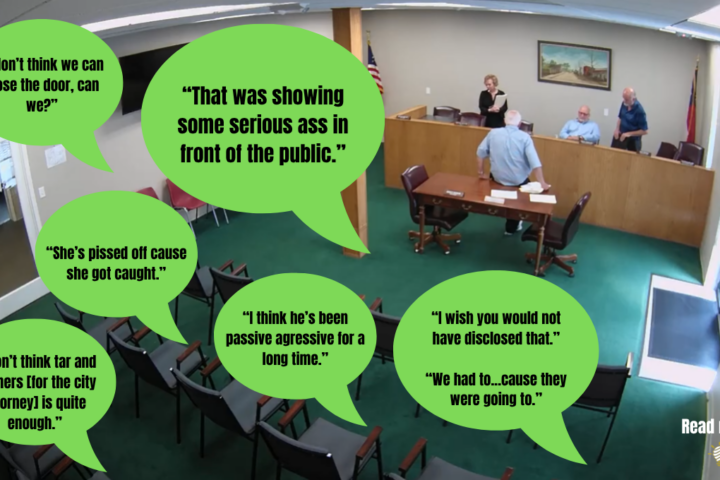
In the now-viral city hall after-meeting meeting footage released in May 2026, Mayor Bernie Weaver told fellow council members that Hugh McCullough told them one of the reasons he departed after 32 years of serving the city was because of the Knights case. In elaborating, Weaver said that it bothered McCullough that the city went through with the legal process, waited for a judge’s ruling, and then changed the ordinance anyway.
According to municode, which is the online hosting site for city charters and codes of ordinances, the open burning ordinance was amended in October 2025, just ahead of the highly contested city council elections, and again in November 2025. The amendment to the air quality ordinance essentially provided a framework for open burning of debris and understory within the city limits of Glennville.
You can read the meeting minutes from the special-called meeting below. All other case file documents are below the minutes.
- Read the complaint by the City of Glennville against Jerry & Louis Knight
- Verification from Mayor Bernie Weaver
- Certification attesting phone calls were made re: a restraining order
- Preliminary Injunction/Restraining Order against Knights signed by Judge Hendrix
- Response from the Knights
- Final Order for Judge Hendrix – July 2025
- Hearing Transcript from May 6 hearing in Superior Court
- Special-Called Meeting minutes – October 23, 2025




Seems we need to drain the swamp in Glennville too