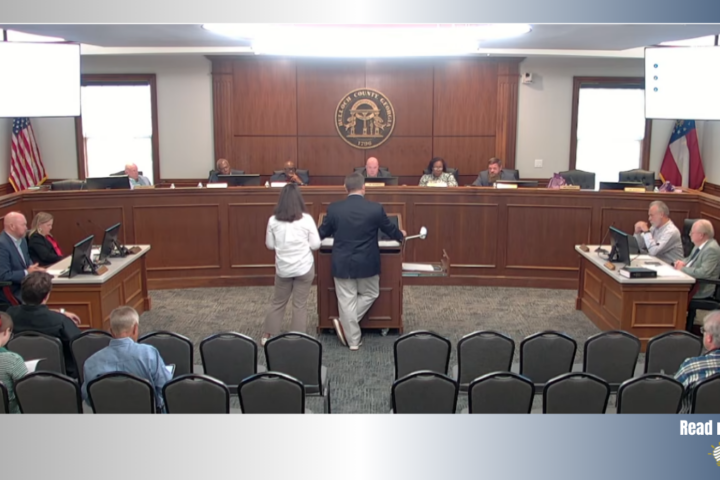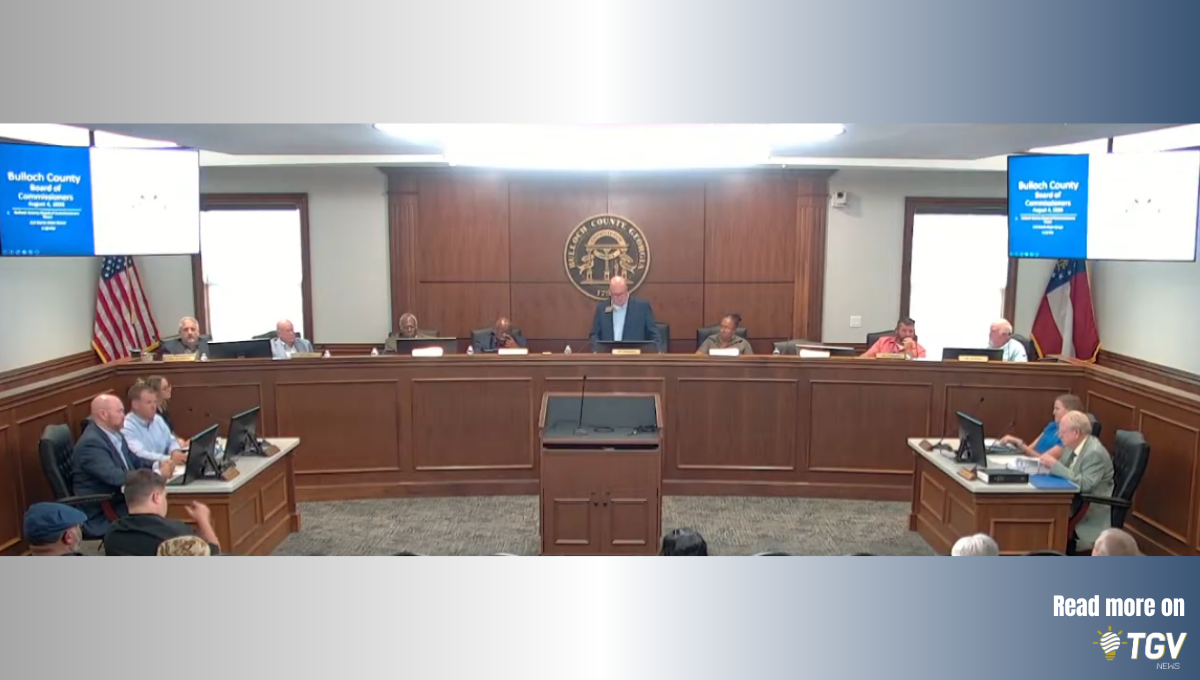
Bulloch County officials released a draft Capital Improvements Element (CIE) ahead of Tuesday’s county commission meeting, a planning document that appropriates millions of dollars in future public infrastructure investments stemming from the implementation of development impact fees on new construction.
Paige Hatley of Hatley Plans LLC was present to offer details on the DRAFT document for submission to the Georgia Department of Community Affairs. This does not mean the county has adopted any impact fees, but rather, the county is moving forward with the process to explore implementation of impact fees.
A CIE is required to collect a one-time “impact fee” from new development as a funding source to help pay for future facility needs.
Bulloch County’s CIE addresses recreation, libraries, roads, and all public safety categories. Specifically, the plan seeks to identify additional public facilities needed to serve growth over the next 20 years, based on population, housing, and employment projections as well as transportation plans and fire studies. If a project is not in the CIE, the impact fee funds cannot be used for it.
The CIE is one of two documents required for an impact fee program but is the only document that requires state approval. Once the document receives state approval, the county will draft a Development Fee Ordinance.
Important to note, unlike property taxes, impact fees cannot be used to fix existing deficiencies or replace aging facilities. Georgia law limits their use to expanding public facilities needed because of future growth, with current residents continuing to bear responsibility for correcting existing infrastructure shortfalls.
Growth Driving the Plan
Substantial growth is expected in Bulloch County over the next two decades.
Between 2026 and 2045, Bulloch County is expected to add more than 24,000 new residents, nearly 6,800 additional jobs, and over 10,000 housing units.
The county’s total residential population is projected to increase from approximately 88,200 residents to more than 112,000. Similarly, the total day-night population is expected to climb from roughly 117,600 to more than 148,400 people. The day-night population is used for public safety planning.
Those projections serve as the basis for calculating future demand across virtually every county service, from parks and libraries to fire protection and law enforcement. Notably, the project list can be updated annually.
Recreation System Would See Major Expansion
Among the largest proposed investments is the county recreation system.
The plan anticipates adding numerous new recreational amenities over the next two decades, including:
- approximately 112 acres of new parkland
- 536 acres of protected open space
- 10 additional athletic fields
- new concession and restroom buildings
- recreation buildings
- Basketball courts, racket courts, fitness stations, pavilions, playgrounds, a skatepark, and an archery course
- Additional park trails and new water amenities
- nearly 800 additional parking spaces
Recreation improvements in the draft total nearly $53 million, with projects phased in between 2030 and 2035. Most of those costs would qualify for impact-fee funding because they are directly tied to projected growth.
Library Expansion Includes Satellite Branch
The county currently operates a single Statesboro-Bulloch County Library. To maintain today’s level of service as the population grows, the report states that Bulloch County will need 8,619 additional square feet of library space and 9,785 additional library materials
The total impact fee-eligible library investment exceeds $4 million.
Fire Department Expansion
The draft outlines an extensive expansion of Bulloch County Fire Department facilities and equipment to accommodate future growth outside the City of Statesboro, which maintains its own municipal fire department.
Plans include:
- nearly 28,800 square feet of additional station space
- replacement and expansion of multiple existing fire stations
- construction of a new Fire Station 18
- an additional future fire station
- expanded fire apparatus fleet
Because portions of several projects replace existing buildings, only the additional square footage created by those projects qualifies for impact-fee funding.
EMS Expansion Planned
Emergency Medical Services would also grow significantly.
The plan identifies demand for:
- more than 3,100 square feet of additional EMS facility space
- four additional ambulances or specialized vehicles
- two future EMS stations located in different parts of the county
As with fire protection, only the additional capacity attributable to future growth would qualify for impact-fee funding.
Emergency Operations and 911 Improvements
Emergency Management would plan for an expansion of the Emergency Operations Center, development of a Community Resiliency Center, and additional emergency vehicles and specialized equipment.
Meanwhile, Emergency Communications planning includes:
- expansion of the E-911 Center
- a backup communications center
- additional dispatcher consoles and communications equipment
In both cases, the report concludes that only portions of the projects are attributable to future growth, meaning impact fees would cover only part of their costs.
Animal Control Facility Proposed
The county also proposes constructing a new 4,000-square-foot animal adoption center while adding additional vehicles for Animal Control operations.
Because projected growth accounts for only about 1,837 square feet of new demand, less than half of the building would be eligible for impact-fee funding, with the remainder requiring other revenue sources.
Sheriff’s Office Expansion
The Sheriff’s Office would see one of the largest facility expansions identified in the report.
Future demand calculations call for more than 52,000 square feet of additional law enforcement space.
Projects discussed include an expansion of the Public Safety Complex, a Real-Time Crime Center (RTCC), a K-9 training facility, and additional specialized vehicles and equipment.
The report notes the county has already approved bonds for portions of the Public Safety Complex expansion, with SPLOST expected to repay that debt. However, impact fees could potentially be applied toward debt service for the growth-related portion of the project.
Road Projects Total Millions
The draft CIE identifies projects intended to increase roadway capacity. Among those listed are:
- Old Highway 46 to Mud Road connection
- Highway 67 at Burkhalter Road turn lanes
- Old Highway 46 and Arcola Road roundabout
- Country Club Road and Highpoint Road roundabout
- Langston Chapel Road and Lanier Drive roundabout
- Brooklet-Denmark Road at Rushing Road roundabout
Based on traffic modeling, planners estimate ~19.55% of future traffic will be generated by new development, making that percentage of eligible roadway construction costs available for impact-fee funding. The report estimates roughly $7 million in road project costs could qualify.
Commissioner Comments
Commissioner Timmy Rushing asked Hatley ‘what all the impact fees would apply to,’ asking if it was ‘anything you had to put a permit on.’ Hatley told commissioners that building permits are the ‘triggering mechanism,’ so any new development – new rooftops, new dwelling units, and any non-residential commercial development. It would not apply to remodels or expansions of existing homes.
Rushing said everyone is “on board with the commercial side,” but has a concern over the guy who just bought 50 acres of land and is going to place a mobile home on the property while they are building their home on the same property. “Now he’s thinking he’ll be…have to pay $3,000 to $5,000 in impact fees. If that’s the case, when the impact fees are implicated, somebody that moves a mobile home in there like that, somebody that moves a mobile home in there like that to build their house they would have to pay $5…or whatever the impact fee is on the mobile home, and then when they build their house, they have to pay that impact fee.” He asked if when the mobile home is moved, if the next person will also have to pay the impact fee.
Hatley said mobile homes are ‘one and done’ for impact fees, even when relocated.
Rushing then asked about agriculture buildings, but Hatley said accessory buildings and buildings that are part of someone’s residence are not included.
Commissioner Simmons asked if contractors would pay if they’re building houses because it’s already hard for first-time home buyers and a contractor would “just pass that off” to the homeowner.
Commissioner Toby Conner asked if his son builds a house on land they already own, if he would be subject to an impact fee. Hatley replied that he would because it’s a new development.
“I just want to get that out there. It is whatever is built, what your children build, from now on,” Conner said, lamenting that this would not be limited to subdivisions only.
Hatley said they are bound by state law with ‘land use’ and that it has to be equitable.
PUBLIC COMMENTS
Reginald Mosley from Portal spoke about the impacts, saying it is a new tax and that commissioners should consider not applying the impact fees to individuals trying to build a house. He said it should be attached to those who have millions of dollars and are building multiple homes. “If there’s an opportunity to not tax the local residents, I would say take that opportunity.”
William Elmly said when he brought up impact years ago, he was referring to projects that have an impact on services, like fire, EMS, and roads, to offset the increased draw on essential services. He said the uproar was over industries coming while receiving abatements and doing nothing to pay for their ‘impact’ on resources – all while taxes increased.
Michael Bailey said he was upset by the proposal because it’s a new tax. “They’re gonna pass it down to the people…Call it what you want, put a pretty title on it, let’s slap it on the butt, and send it on through,” he said, imploring commissioners to ‘really look at it.’