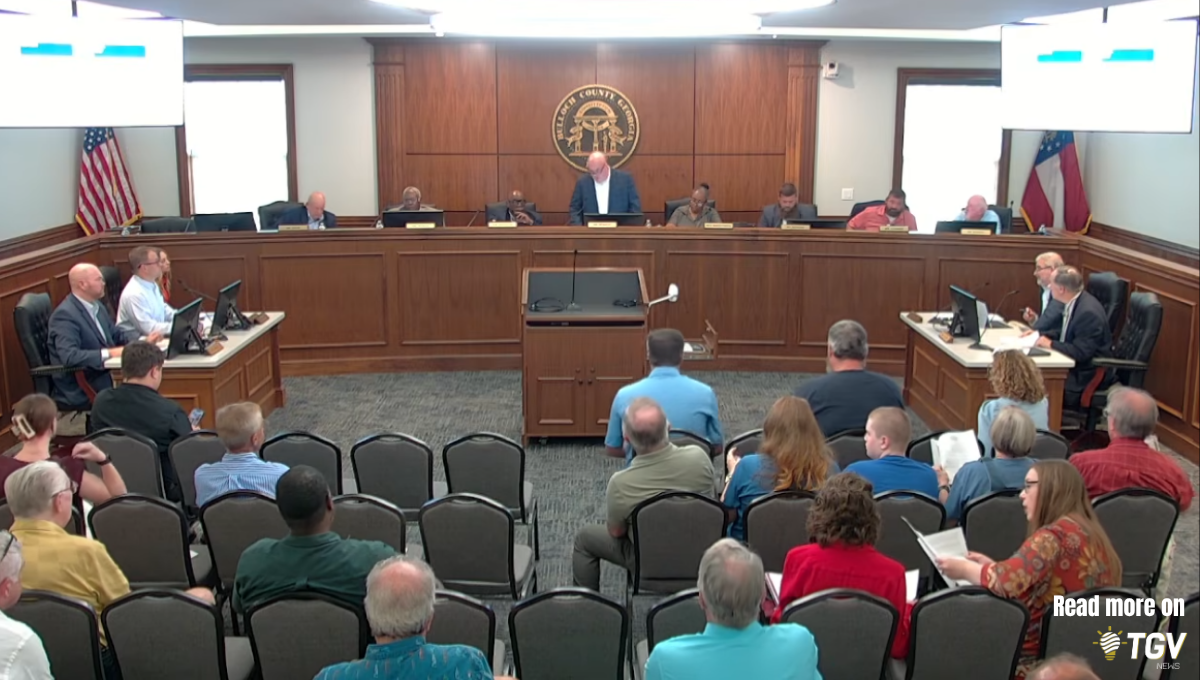
The debate over data centers in Bulloch County is far from settled after county commissioners narrowly rejected an outright ban Tuesday, opting instead to leave the existing moratorium in place while discussions over potential regulations continue.
In a 4-3 vote, the Bulloch County Board of Commissioners denied a proposed text amendment that would have prohibited data centers in unincorporated areas of the county.
A previous county commission meeting back in May resulted in the directive to staff to draft a text amendment prohibiting data centers in unincorporated Bulloch County. The vote to direct staff to do that came after a motion was made by Commissioner Toby Conner and seconded by Commissioner Nick Newkirk.
Staff drafted the amendment and the Planning & Zoning Commission approved the text amendment in a 5-1 vote.
At a meeting in August, the text amendment was presented to commissioners who deadlocked on the issue..
At the second August meeting, a regulatory text amendment to allow data centers was also presented.
Tuesday, Planning & Zoning Director Jeff Pope once again presented to commissioners, this time with the outright ban once again in the text amendment. Pope told commissioners a zoning ordinance would define a data center so that if an application came in for a building or zoning permit, the county could point to the ordinance and say “it’s recognized by ordinance but not allowed.” The ordinance would also clarify what a data center is not: a data center is not general business, heavy manufacturing, or light manufacturing.
“Staff is comfortable in saying this would meet what we were directed to do which would not allow data centers in Bulloch County,” Pope said.
Chairman David Bennett clarified that the vote was not on any zoning amendment for data centers, but rather to accept or deny text creating a ban on data centers.
“If we do not accept this text, the moratorium continues on until the 31st of December, is that correct?” Bennett asked, which was affirmed by Pope.
Public Comments
Ben Watkins – Addressed commissioners to discuss economic development and what data centers mean to the Bulloch County community. He said the conversation should be around Bulloch County facts and circumstances. He said data centers shouldn’t be banned, but a set of standards should be defined, especially for those that address legitimate concerns, like noise, water, and power. He added that most of the complaints about Georgia data centers stem from the construction, not the actual data center. He said construction should be addressed in the ordinance as well. He said most people, when the word data center is removed, will pick a project that generates the most revenue and has the least impact on county resources.
Watkins also added that he lives in close proximity to the industrial park, so he understands the consequences of his recommendations.
At that point, citizen Sarah Thompson rose to interrupt and said they should act as a team and she would like to speak.
County Clerk Venus White then asked Thompson if she was in favor, against, or undecided. Thompson replied that she didn’t mark anything. White said she understood but that there were other people who signed up to speak in front of her and they go in order based on ‘position.’ Thompson indicated she wished to be identified as ‘undecided.’ White told Thompson that three others were ahead of her on the sign-up sheet and then she would be recognized. Thompson asked if everyone could just have two minutes, but White explained that it was a zoning matter, not a public hearing, which means each side gets ten minutes.
Chairman David Bennett clarified that this is the procedure and for zoning hearings and while people often don’t coordinate, they make it work. He said he would allocate 2 minutes to the remaining undecided individuals.
Jackie Fields – Lives in close proximity to the proposed data center location that’s within the city limits of Statesboro. She asked if any environmental studies had been completed and if they were available to the public. She also asked if there were any positive comments from owners already impacted. “I know these data centers are inevitable. I’m just asking that if Statesboro is determined to approve them, let them only be in unpopulated industrial areas.”
Lindsey Williams – She said the decision belongs to the citizens. The real question is whether or not Bulloch County has the infrastructure to support a data center. She said a high voltage transmission line does not indicate whether or not the land can support the use, wastewater capacity, water, noise, or anything else. She said the facilities should be evaluated by the type of center and their size, not just ‘data centers’ generally. Williams also addressed noise, meaningful setbacks, and other things before residents begin seeing impacts.
Alana Olson – Olson presented a packet to commissioners before beginning her presentation. She said she doesn’t think 30 days from the last time they didn’t have enough information to make a decision is enough time to gather the needed information and said 90 days would be a perfectly good decision. “If you can’t feel confident in an outright exclusion, there’s a great way to look at performance-based zoning,” she said. She said there are resources about smart zoning decisions. “If we’re going to have an ordinance, let’s have a strong one.”
Sarah Thompson – Thompson told commissioners that her decision was not ‘undecided’ on the issue, as previously stated, but “for the United States Constitution.”
“This is an unconstitutional consideration because there is a permanent moratorium in place. The permanent moratorium is the Fifth Amendment of the United States Constitution. That prohibits the deprivation and use of property without due process of law. The people must receive more respect.” She then went on to address eminent domain, which she said is essentially what placing a data center amounts to.
“I’m not here to lobby you, I’m here to direct you. We are the sovereigns. We are of the most high.…we supersede you. You are our trustees and servants. I have a Masters in Law with a compliance emphasis and I am also married to an esteemed man who has a Masters in National Security from the Naval War College and went to Annapolis. I suggest that you pay attention. This data center stuff here, is public use. You can’t do zoning and districting for public use. You cannot do this.”
Dean Rekowski – He began by referencing an article in the newspaper, Newkirk’s reference to the referendum on the primary ballot with people opposing data centers, and Chairman Bennett’s contention that people changed their minds.
“I applaud what you’re doing in terms of the investigation, but Mr. Bennett, you didn’t say how many people had changed their mind, but I speculate that it wasn’t 5,700 people that came and talked to you,” he said. He suggested at the end of the investigation, they should poll the people and follow the will of the people.
Eddie Smith – Said he spoke with many people in town about whether or not they want a data center, the majority don’t. Those that do, he said, are clueless to the real impacts of the real impacts. He said they absolutely have to have one, it should be as far away from people as possible.
“I say no, personally and I think y’all should say no…Don’t do what the people don’t want. This is our county, not the data center’s county. Listen to the people. We vote for all y’all. If you do what we do not want, you will not have a job. Think about these things. That’s who we’re here to represent and we don’t want this.”
Frank Davis – Said he was the only one present to speak in favor of data centers. He said the most common complaint is taxes and the budget. He also said that most people don’t understand why they’re against data centers despite them being the most realistic way to lower property taxes. He said the opposition to data centers is rooted in misinformation and disinformation and that social media opposition may be from ‘adversaries.’ He said when he thinks of data centers, he hears lower property taxes, better schools, and enhanced fire/EMS/law enforcement services.
Presentation from Commissioner Nick Newkirk
Commissioner Nick Newkirk presented a PowerPoint presentation on a data center he visited last week.
He said he didn’t make it to the county data center trip ‘up north,’ but recently took his own trip on his own dime to visit Colossus 2 in Memphis, TN. He said he had been weary of taking a trip organized by the Development Authority.
The presentation detailed what Newkirk “personally witnessed firsthand” during an unsupervised visit to the center. He toured the exterior of the facility and the surrounding communities to understand the physical footprint of a data center and its impact on the surrounding community.
Newkirk took decibel readings outside the data center:
- Scaife Road – 66db @ 600 feet (already online)
- Key Collision of South Haven – 64 dB @ 500 ft (in the process of coming down)
- Cul-de-sac Aaron Lane – 63 dB @ 1,500 ft
- Jerry Street Park – 50 dB @ 2,000 ft. ( the second 2 used to be Duke Energy Power. Power is made on-site with 50 gas turbines running)
Newkirk said data centers run 24/7, the sound is continuous, and when there is a loss of power, generators kick on.
“I’ve never seen so many power lines in my life,” Newkirk said, adding that he counted 38-40 actual power lines on the poles from the south side of the industrial park to the north.
He also said they’re building 50-60 foot walls around the facility trying to cut down on the noise impacting nearby parks and communities.
Some have compared data centers to concrete and asphalt plants, which do not run 24/7. Newkirk said he visited concrete facilities and reported the following readings:
- Kennedy Concrete on South Zetterower – 50-55 dB @ 650 ft, occasional 61 dB
- Reeves Asphalt Plant on Highway 301 S – 55-60 dB @ 650 ft
- SRM Concrete on Highway 301 S – 50-55 dB @ 400 ft, occasional 63 dB
Newkirk then reiterated that the primary referendum in 2026 regarding data centers resulted in 76% of Republicans opposing and 78% of Democrats opposing.
He then offered a speaker simulation of 60 decibels with a speaker in the room.
“The citizens of the county voted NO on this in May and I’m going to uphold their wishes and I’m going to fight for it until we have another vote that the citizens want,” Newkirk closed before he was met with an applause from the crowd.
Commissioner Comments
Commissioner Timmy Rushing asked Pope if anyone had reached out about a data center. Pope said no.
“What I’m hearing from not everybody but the majority whether for or against it is we got a moratorium on it ‘til January and nobody in this room knows all the facts. Especially me. And I’m not gonna be here…but we have a moratorium that’s in place ‘til January. You’ve done started on guardrails and guidelines if there ever was a data center in Bulloch County.”
Commissioner Toby Conner said he didn’t think the Board would have all the answers by December or even December 2027, noting that it could be four or five years down the road before those answers come.
“I don’t want it by my land, no way shape, form or fashion and I sure ain’t gonna put it on nobody else. My point is let’s ban this thing, get away from having the moratoriums, we can watch what’s going on around us,” Conner said. “We don’t have to be first in this race. Let’s just sit back and learn something.”
Commissioner Timmy Rushing said he was not ‘for or against data centers,’ but he is for the grant money that Bulloch County gets from the State of Georgia and he didn’t want to put a black eye on Bulloch County because Bulloch County is negative about everything going on.
Commissioner Ray Davis said the purpose of looking at data centers was to lower taxes.
“If we don’t find some way to lower taxes, they’re gonna go up by inflation or we’re gonna have to cut services. This is an opportunity to look,” Davis said.
Commissioner Rushing then made a motion to DENY the text amendment that would ban data centers entirely and leave the moratorium in place through December 31, 2026. The motion was seconded by Commissioner Ray Davis.
Commissioners Rushing, Davis, and Mosley voted to DENY the text amendment to ban data centers.
Commissioners Newkirk, Conner, and Simmons voted NO on DENYING the text amendment to ban data centers.
Chairman David Bennett broke the tie and voted with Rushing, Davis, and Mosley, saying an outright ban would put the county in legal jeopardy. He also said the issues people have discussed can be mitigated.
As a result, the text amendment banning data centers was DENIED in a vote of 4-3.