
A recently closed investigation by the GBI into the City of Reidsville shows a litany of financial discrepancies ranging from undocumented bonuses for elected officials, garnishment payoffs for a former police officer, and ‘Promissory Books’ for people to ‘pay what they can’ on city water bills. All three of the issues are a violation of the Gratuities Clause in the Georgia Constitution.
The investigation is the result of a request by Reidsville Mayor Vickie Nail. On May 12, Nail asked Police Chief Matt Lynn to seek assistance from the GBI to conduct a preliminary investigation into potential financial irregularities and possible mismanagement of city funds. The case was assigned to GBI Agent Joe Cephus.
The preliminary investigation resulted in a number of findings, some of which are barred by the statute of limitations and others which will not be prosecuted due to the “the overwhelming number of poor practices and improper training” among city employees.
What is the Gratuities Clause?
The Gratuities Clause is a section in the Georgia Constitution (See Article III, Section VI Paragraph VI) which prohibits the General Assembly from using tax dollars or state property to donate, offer a gratuity (a gift), or forgive a debt or other obligation of a private entity or individual when there is no substantial benefit to the entity. (emphasis added)
The Georgia Supreme Court extended the Gratuities Clause to cities, counties, and school boards decades ago and the Georgia Attorney General has echoed the position for years, time and time again erring on the side of the state constitution.
Under Georgia law, the Gratuities Clause specifically defines ‘substantial benefit’ exclusions as:
- Monetary consideration (like receiving monetary benefit in return for a product or service)
- Instances where the ‘substantial benefits’ are received in return…Privatization of services (See Smith et. Al v. Board of Commissioners of Hall County and the Op. Atty Gen. 70-28) [in these instances, distinct contracts for services exist]
- Reduced administrative burden (Op. Atty General 73-145)
- Purely charitable purposes as defined by the IRS code and includes things like advancement of religion, relief of the poor (See Ga Constitution Article XI Sec II Para VIII)
- Public welfare (like the state offering unemployment seminars for free or county hospital care for the poor (the authority to make charitable contributions must be specifically granted by the General Assembly in a general statute)
- Direct benefit to the public which also takes into account the benefit the donating local government entity is receiving in return (Op. Att’y Gen.81-17)
GBI INVESTIGATION
Retention Bonuses
Records show that city officials provided themselves with an end of the year ‘bonus’ for their service to the taxpayers.
Aside from the fact that the bonuses were not voted on in a city council meeting, ‘bonuses’ for elected officials are strictly prohibited by the Georgia Constitution’s ‘Gratuities Clause’ as well as the oath taken by elected officials when they take office each term.
But in November of 2021, elected officials received a ‘retention incentive’ for the pay period beginning 11/19/21 and ending 11/19/21, according to pay stubs. The stub provided to the GBI are coded ‘0008 RETEN – RETENTION INCEN’ as opposed to the monthly pay compensation, which is coded ‘0002 – SAL – MONTHLY. Additional records indicate the money was paid with funds given to the city under the American Rescue Plan Act.
The following ‘retention incentives’ were issued to elected officials:
| POSITION | RETENTION INCENTIVE BONUS (GROSS) on 11/19/21 | Check # | NET AMOUNT | |
| Mayor | Curtis Colwell | $510.19 | 95401 | $471.16 |
| Councilperson | Lindsay Bennett | $510.19 | 95400 | $471.16 |
| Councilperson | Bruce Conner | $510.19 | 95402 | $471.16 |
| Councilperson | Carolyn Crume-Blackshear | $810.19 | 95403 | $748.21 |
| Councilperson | Verdie Williams | $510.19 | 95406 | $471.16 |
| Councilperson | Doug Williams | $510.19 | 95046 | $471.16 |
Pay stubs reflect base compensation of $250 per month, sometimes paid in the following month based on when payroll was run and when the pay period ended.
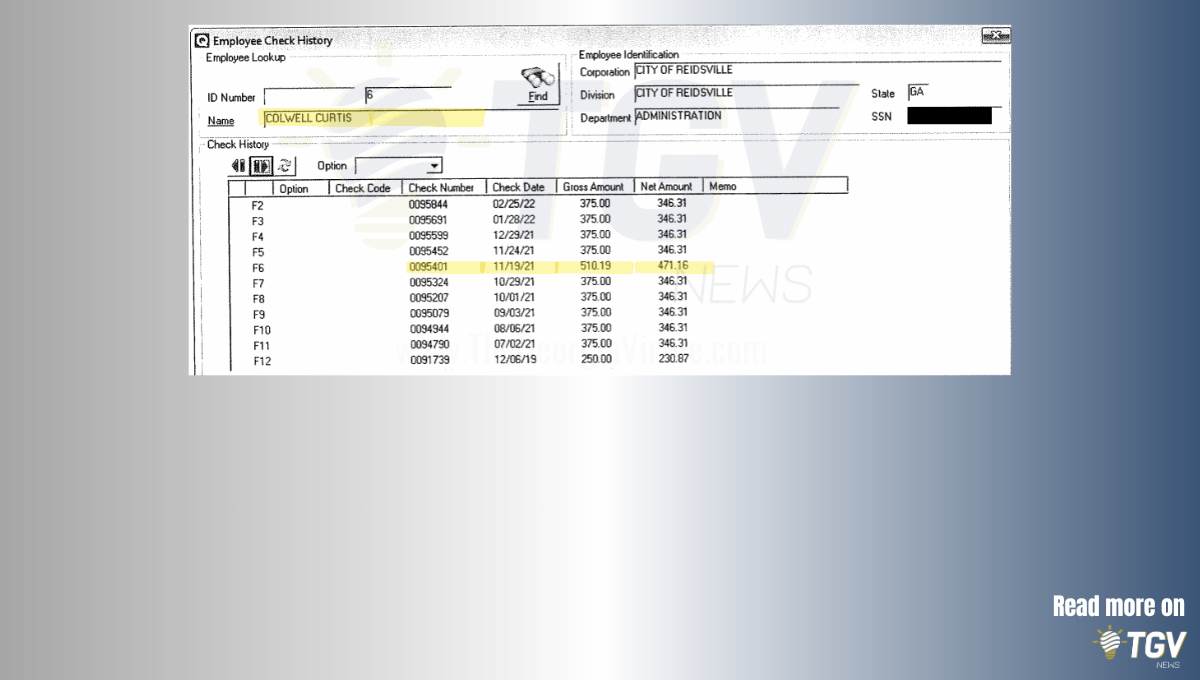
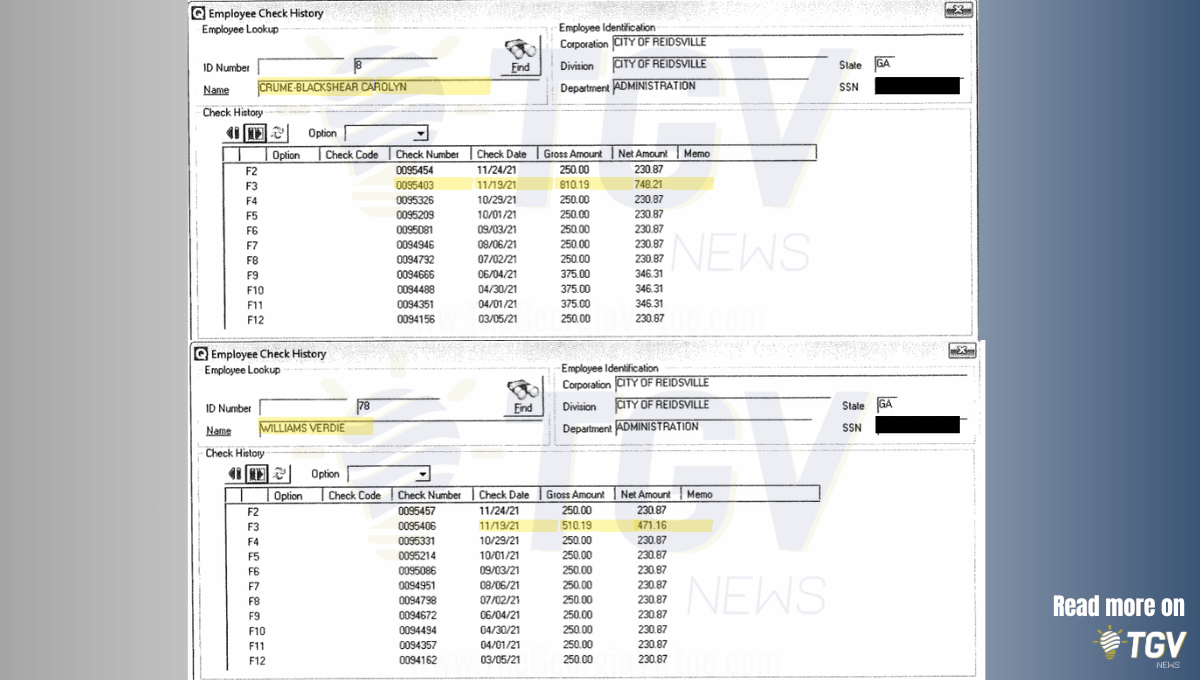
Notably, Curtis Colwell routinely signed his own checks, whether they were for regular compensation or additional compensation, a practice that is discouraged by most reputable financial auditors.
Payoff of Garnishment of a Former City Employee
The investigation also revealed that the city paid off a hefty personal debt for former Reidsville Police Officer Anderson Deliford just one month before then-Police Chief Stacey Wilds placed Deliford on leave and eventually recommended his termination in a 5-page report detailing a lengthy list of policy violations. That decision to terminate Deliford was overridden by Mayor Colwell and Colwell directed city staff to pay Deliford for the days he was on leave.
But records show that a few weeks before Deliford’s employment was on the chopping block, the city took an axe to a personal debt on behalf of Deliford.
On July 18, 2022, a judgment for wage garnishment was ordered against Deliford for an unpaid debt in the amount of $8,521.95. The judgement was ordered in Liberty County Magistrate Court and subsequently transferred to Tattnall due to Deliford’s employment in Reidsville.
A check dated July 18, 2022 from the City of Reidville’s bank account made payable to Okinus Inc. and signed by Mayor Curtis Colwell was issued in the amount of $8,521.95. Former City Clerk Nivea Jackson’s signature also appears on the check endorsement. The receipt dated July 22, 2022 from the Magistrate Court lists ‘2022-22CG-DF-1 Anderson Deliford’ as the the purpose of the $8,521.95 paid. The same day, an ‘Release of Garnishment’ was issued by Judge Anderson indicating that Deliford’s garnishment had been “PAID IN FULL AS OF 7-22-22.”
In June 2023, a Promissory Note between Deliford and the City of Reidsville was signed, outlining that Deliford was ordered to pay $3,587.43 in installments of $150 per month.. The Promissory Note was signed at 0% interest and included signatures of Anderson Deliford and Mayor Curtis Colwell. City Clerk Nivea Jackson attested to the document and was the Notary Public for both signatures.
The documents were turned over to the GBI because Deliford has failed to make payments on the promissory note since signing the note, meaning the City is still on the hook for Deliford’s debt. The balance remains $3,587.43.
Promissory Books
According to records obtained by TheGeorgiaVirtue, the City of Reidsville was offering some citizens the opportunity to make partial payments on city water bills.
Mayor Vickie Nail wrote in a 2026 memo that she became aware of the practice on the same date after being asked about a ‘promissory note’ kept in a black notebook. The question was brought to her by a part-time intern, but Nail was unaware of the use of the notebook and asked to review it.
“I noticed numerous pages with customers’ names signing a “City of Reidsville Promissory Note” and the actions were signed by staff and sometimes council. This occurred when Mayor Colwell was in office, and when the city had a Finance Committee, which consisted of Council Carolyn Blackshear and Council Verdie Williams. I questioned the City Clerk, Nivea Jackson about this matter. She stated that this is something the finance committee came up with and was approved by council. I could find no minutes where this was brought before council.”
Nail also wrote in the memo that the book referenced a city ordinance regarding deposits, discontinuation of service for nonpayment, and reinstatement of services. The ordinance, however, makes no mention of a promissory note or a promissory note practice.
Absent a formal and structured plan approved by city council under a lawful ordinance, the practice of payment plans and ‘write offs’ for city services is strictly prohibited under Georgia law.
The form that water customers signed lists ‘August 2022’ as the creation date and lists the previous administration of Colewell, Blackshear, Lindsay Bennet, Doug Williams, and Verdie Williams.
Many of the forms for customers contained within the promissory books included forms with no listed ‘amounts owed’ and reflect no eventual payments to ‘make good’ on the promissory note. A handful of the promissory notes are not signed by any city staff at all. In total, promissory book options were offered for customers at least 59 times between 2022 and 2023, each with their own unique terms and conditions, handwritten by whichever staff or council person was handling the note.
In August 2022, Councilperson Verdie Williams appeared on the signature line as the reviewing for a customer with an incomplete name. In May of 2023 and again in June 2023, then-mayor Curtis Colwell was the reviewing official on the provisions.
A few examples of the promissory book forms:
Out of Control Water Account Adjustments
A tangential issue with the water bills also landed on the GBI’s radar for investigation.
Some adjustments to water accounts are normal over the course of any given fiscal year. Usually, adjustments across all accounts for a single year average around $9,000, largely for fire department usage and other city properties. Prior to 2021, the adjustments ranged from $7,000 to $9,000.
When City Clerk Nivea Jackson was hired and began managing the water accounts, adjustments skyrocketed. In the first nine months of her oversight, adjustments totaled $9 million.
From 2022 to 2025, Jackson and one other city employee handled the water accounts and subsequent adjustments, many of which were ‘mis-entries. Total adjustments ranged from $1.04 million in 2022, to $122,387 in 2023, to $71,562.63 in 2024, and $831,534 in 2025.
The real issue with the water account financials was revealed upon the instillation of the new meters in the city limits, which are no longer read manually, and the discovery of the promissory book allowing partial payments.
The numbers are recorded as losses on paper, though the actual losses are unknown due to records being unavailable.
Since the issue was discovered by Mayor Nail, she has required additional checks on adjustments and no adjustments may be made to water accounts unless approved by the mayor.
Consultation with District Attorney
GBI Agent Cephus met with District Attorney Billy Joe Nelson, ADA Joe Skeens, and ADA Russell Jones on May 15 to discuss the findings of the investigation.
The investigative case summary stated the following:
Regarding the issue of the personal debt being paid with public funds, officials advised the circumstances of this case did not meet the elements of any applicable Georgia criminal statute, and this incident may be better handled through civil litigation.
Regarding the supplemental checks issued [to city officials*] from the general city funds, it appeared the matter exceeded the applicable statute of limitations under Georgia law.
Lastly, regarding the water bill incident, officials determined the matter would not be prosecuted due to the overwhelming number of poor practices, improper training, and the lack of personal profit or gain by the subject involved in the case.
Agent Cephus notified Mayor Vickie Nail and Police Chief Matt Lynn of the findings as well as the determinations by the District Attorney’s Office shortly thereafter. The case was subsequently closed.
*clarification added as the GBI referred to the retention incentive checks as ‘supplemental checks’ while the TGV article refers to the checks as ‘retention incentive’ checks.