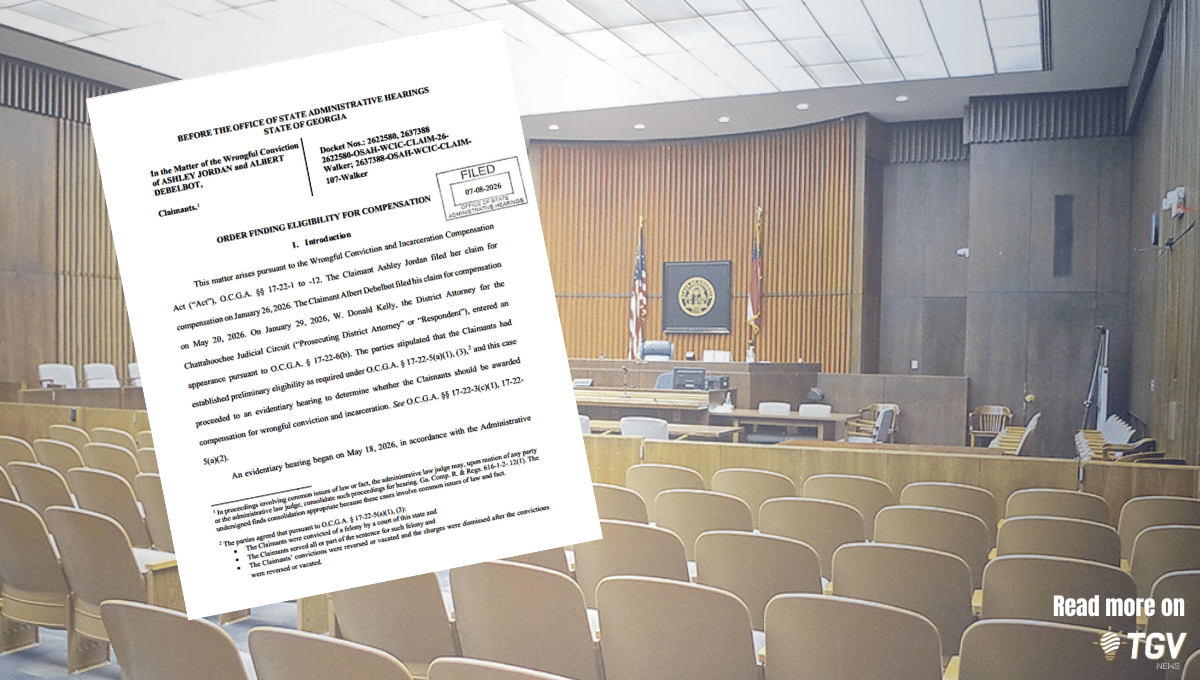
More than 18 years after their newborn daughter died, and nearly six years after the Georgia Supreme Court overturned their murder convictions, an administrative law judge has ruled that Ashley Jordan and Albert Debelbot meet the requirements to receive compensation under Georgia’s Wrongful Conviction and Incarceration Compensation Act.
The 41-page order issued by Georgia’s Office of State Administrative Hearings does not award a specific dollar amount for the two, but says the two can receive compensation because they spent time in prison for crimes they did not commit.
BACKGROUND
Back in June 2008, Columbus police investigated the death of McKenzy Debelbot, born just three days earlier at Martin Army Community Hospital in Columbus.
Ashley Jordan and Albert Debelbot met in the armed forces while serving in South Korea. They married and moved to Fort Benning where both served until Jordan became pregnant. Debelbot continued to serve and the pair welcomed a baby girl on May 29, 2008. The day after the family was discharged from the hospital, they fed, bathed and cared for McKenzy before putting her to bed. Later that night, Ashley Jordan noticed a swollen area on the baby’s head, contacted the hospital and immediately took McKenzy to the emergency room. Despite emergency treatment, McKenzy died a few hours after arriving at the ER.
Both were front and center for law enforcement from the beginning, despite both Jordan and Debelbot maintaining that they had not injured the baby and that they did not believe the other injured the baby either. Both also asserted that they would not ‘cover’ for the other if they believed the other had hurt the baby. Still, they were arrested for murder on June 2, 2008.
A year later, in June 2009, Jordan and Debelbot, were indicted on charges of Malice Murder, Felony Murder, and Cruelty to Children (1st degree).
At trial, prosecutors relied on testimony from Dr. Lora Darrisaw, Deputy Chief Medical Examiner for the Georgia Bureau of Investigation. Darrisaw determined in her examination that McKenzy had suffered fatal blunt force trauma after leaving the hospital. She classified the death as a homicide. Defense attorneys did not use medical experts at trial and both Jordan and Debelbot were convicted and sentenced to life in prison.
Years of Appeals Changed the Scientific Picture
Following their convictions, both parents sought new trials.
In a 2015 hearing for the Motion for a New Trial, defense attorneys presented four medical experts, all of whom challenged the state’s narrative. They argued that McKenzy’s health issues originated before birth and during delivery, not after discharge from the hospital.
The hearing(s) spanned more than two years and 2,000 pages of transcripts, but the trial court denied the motion for a new trial, claiming the experts presented were not credible. Both parents appealed.
A decade after their convictions, in 2019, the Georgia Supreme Court vacated the trial court’s order, writing that the Chattahoochee Judicial Circuit judge’s “limited findings in the light of the voluminous testimony” had denied the Court the opportunity for meaningful review The case was sent back down, but the trial court again denied the motion for a new trial.
In 2020, the Georgia Supreme Court reversed the convictions, holding that defense attorneys had provided ineffective assistance by failing to object when prosecutors misstated the law during closing arguments. The Court concluded there was a reasonable probability the outcome would have been different absent the error.
Prosecutors declined to try the case again and dismissed all charges against both Jordan and Debelbot, but the dismissal of charges is not bookend to be eligible for compensation, as it does not necessarily mean someone was wrongfully convicted.
Throughout the entirety, Jordan and Debelbot, denied harming their daughter.
Wrongful Conviction Law Requires More Than Reversal
Under Georgia’s Wrongful Conviction and Incarceration Compensation Act, a person must prove more than simply having their convictions overturned. First, they must establish they were convicted of a felony, served part of the sentence, had the conviction reversed with charges later dismissed, and, perhaps most significantly, that they did not commit the offense or any lesser included offense. They also cannot have acted as accomplices or intentionally protected the actual perpetrator.
The first and third requirements were stipulated by both sides.
At issue in the case of Jordan and Debelbot was whether or not the two had proven they did not cause their daughter’s fatal injuries.
Competing Medical Theories Took Center Stage
In May and June of 2026, Jordan and Debelbot appeared before Judge Ronit Walker, an Administrative Law judge. Attorneys Andrew Fleischman James Anderson represented Jordan and Debelbot. Assistant District Attorney Attorney Frederick Lewis appeared for the state.
During the administrative hearing on the wrongful conviction, they revisited the medical theories of each side.
The State relied on Dr. Darrisaw’s opinions. Darrisaw again testified that McKenzy suffered extensive bilateral skull fractures, subdural hemorrhaging and swelling consistent with severe inflicted blunt-force trauma. In her opinion, the injuries appeared fresh, occurred within roughly eight to twelve hours before death and reflected non-accidental trauma. She maintained the baby’s condition would have deteriorated rapidly after such injuries, making it unlikely they occurred before birth or during delivery.
Darrisaw also testified that although CT scans were performed before the infant died, she did not review them before conducting the autopsy because evaluating radiological imaging is outside her normal practice as a forensic pathologist.
The state also relied on testimony of two doctors – Dr. Susan Palasis and Dr. Robert Zanga – who did not testify during the administrative hearing but had testified in 2015 at the Motion for New Trial.
The defense experts’ conclusions were substantially different.
Dr. Peter Dehnel, a pediatrician from Minnesota, testified in the Motion for New Trial in 2015 as well as the administrative hearing. He’s examined 2,800-3,000 newborns as a doctor of 41 years and Chief of Staff for a children’s hospital in Minnesota. He testified that there were multiple indications that the baby had not developed normally as well as issues during delivery, which required manipulation of the McKenzy’s head and shoulder. Also included in his testimony were nurse’s notes about overlapping sutures and the possibility that McKenzy’s brain was smaller than it should be.
Neuroradiologist Dr. Daniel Sahlein testified that the CT scans revealed evidence of a disease process evolving over days or weeks rather than hours. According to his testimony, the scans showed blood products of varying ages, abnormalities predating birth, brain volume loss and a thrombus within the dural sinus. He concluded the findings overwhelmingly supported an issue in utero as opposed to an event occurring after discharge from the hospital.
Judge Ultimately Finds Jordan & Debelbot Met Their Burden
After reviewing years of testimony, trial transcripts, medical records and expert opinions, Judge Walker concluded that Ashley Jordan and Albert Debelbot did meet the threshold to be eligible for compensation under Georgia Law.
The order explains that the question was not whether prosecutors had sufficient evidence to obtain convictions in 2009, but whether the claimants now proved they did not commit the crimes.
Walker determined they satisfied that burden, rejecting the State’s position that the evidence continued to support a finding of inflicted trauma, including taking issue with the lack of examination of the CT scans by the medical examiner.
The order also states that investigators found no forensic evidence inside the family’s apartment, no indication of drug or alcohol abuse, and no evidence identifying any object or mechanism that allegedly caused the child’s injuries. Judge Walker rejected the state’s evidence at trial – testimony of a convicted felon who claimed Debelbot had told him that Jordan “spanked” McKenzy when he left the home to buy drugs.
Judge Walker wrote that police reports reflected that the parents’ accounts remained largely consistent throughout the investigation, with only minor differences concerning who awoke first after a dream.
“[E]vidence that would have permitted the jury to specifically attribute the infliction of trauma upon McKenzy to either or both of her parents — evidence that Albert alone inflicted the trauma, evidence that Ashley alone inflicted the trauma, or evidence, or evidence that Albert and Ashley both inflicted the trauma — was notably lacking.
Judge Walker wrote that even after Jordan and Debelbot divorced, they “testified, credibly, that they did not hurt their baby and they were confident that their partner would not have done so either.”
What Happens Next?
Now that a judge has determined that Jordan and Debelbot qualify for compensation, a separate determination will establish the amount of compensation each of them should receive.