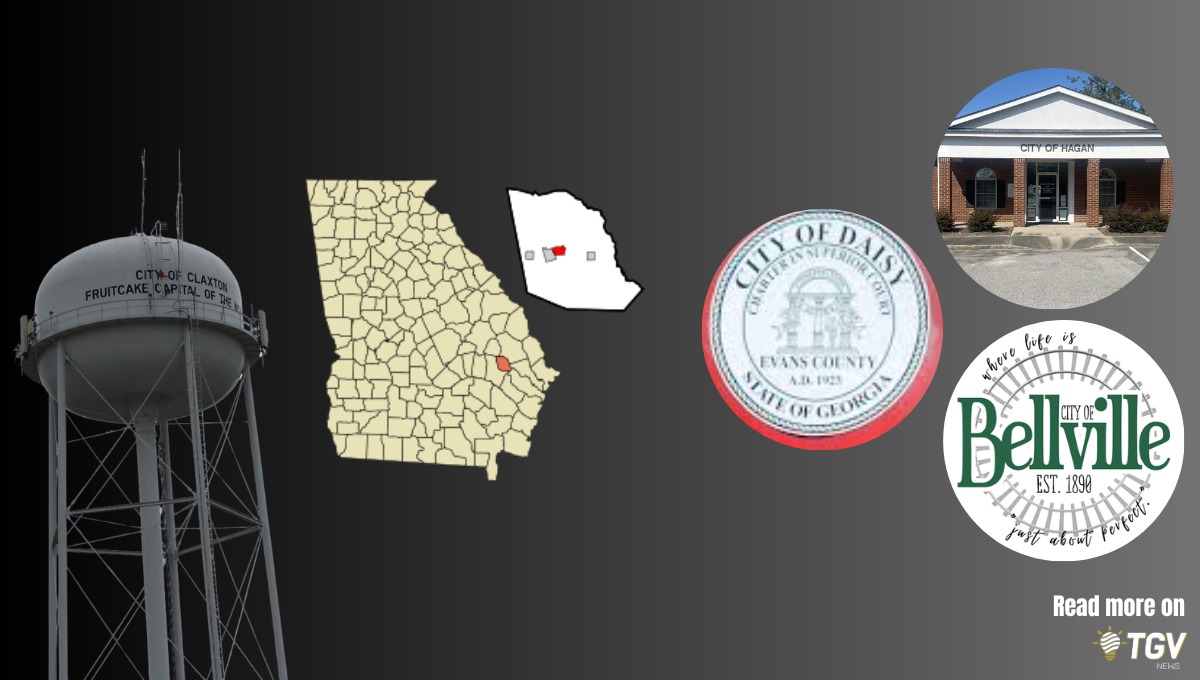
This report has been published following the discussion around consolidation by Evans County Commissioners in February 2026.
In 2017, Evans County and the cities of Claxton, Bellville, Daisy, and Hagan commissioned the University of Georgia’s Carl Vinson Institute of Government to examine the feasibility of consolidating local government operations. The resulting study evaluated both full city-county consolidation and more limited consolidation of specific services, with particular attention to fire protection and law enforcement and the potential for increased efficiency and cost savings.
Researchers reviewed financial and operational records, conducted interviews, and examined consolidation models elsewhere in Georgia. The report did not recommend for or against consolidation; instead, it was intended as a roadmap identifying potential advantages, obstacles, and options. The report also evaluated previous local government cooperation, including recreation, economic development, emergency management, and public works services.
FULL GOVERNMENT CONSOLIDATION
The study found that the financial condition of a new unified government would essentially combine the assets, liabilities, revenues, and obligations of the existing governments. Researchers described the governments as generally being in a strong fiscal position based on their debt-to-asset ratios, but identified several financial complications. Claxton’s municipal utilities, particularly its natural gas system, would have to be addressed, and consolidation would require decisions about combining departments, financial systems, policies, salaries, benefits, assets, and liabilities.
The report identified both potential new revenue and new costs associated with full consolidation. The report estimated that a unified government could generate approximately $402,017 in additional annual franchise-fee revenue from the presently unincorporated area. At the same time, consolidation would eliminate the ability of both city and county governments to separately collect financial-institutions taxes, resulting in an estimated revenue reduction of about $32,926 based on FY 2016 figures. Other transition expenses could include equalizing employee salaries and benefits, upward to the highest existing level, and developing new ordinances and policies, changing financial systems, and absorbing other costs associated with merging operations.
PARTIAL CONSOLIDATION (FUNCTIONAL CONSOLIDATION)
The study identified fire protection and law enforcement as the two services offering the greatest potential for functional consolidation, increased efficiency, and cost savings.
For fire protection, the study determined that the Evans County and Claxton fire departments operated in relatively similar ways and suggested consolidation could produce economies of scale, improve equipment utilization, reduce overlapping service, potentially shorten response times, and possibly improve ISO ratings. Notably, before 2014, Claxton was the primary fire-service provider for much of Evans County before the county established its own department.
For law enforcement, the CVIG examined two principal alternatives: expanding the Evans County Sheriff’s Office to provide countywide law enforcement or expanding municipal police services to additional cities. At the time, Claxton and Hagan maintained police departments while the Sheriff’s Office served the unincorporated county, Daisy, and Bellville. Researchers identified possible duplication in areas such as dispatching and investigations and said consolidation could theoretically reduce duplication, provide more consistent training, and free additional personnel for patrols and calls for service. But a merger would also carry startup costs and require reconciliation of differing policies, equipment, training requirements, and salaries.
The report also considered a combined Claxton-Hagan police department, noting that the cities are contiguous and that such an arrangement could give Hagan 24-hour coverage.
CONCLUSION
CVIG said future functional consolidation could be beneficial and result in higher levels of service, but advised the governments to first understand and resolve the issues that caused previous consolidation arrangements to dissolve. Researchers stressed that successful consolidation would require strong support from elected officials, senior management, and employees in the affected departments. In other words, the study identified viable opportunities for greater cooperation and consolidation in Evans County, particularly in fire and law enforcement, but stopped short of concluding that either full or functional consolidation should occur.