A state court judge has sanctioned the Georgia Department of Corrections for the agency’s failure to comply with the discovery process in a civil suit against the former warden of Smith State Prison and another former prison employee.
The sanctions stem from a civil suit against former Smith SP warden Brian Adams and former employee Ireon Moore, both of whom are being sued for their alleged roles in a purported criminal enterprise operating from behind the walls of the prison at the time of the murder of 88-year-old Bobby Kicklighter.
Background
Kicklighter was murdered in his home on January 30, 2021 in a botched murder-for-hire scheme intended for Kicklighter’s neighbor, a corrections officer at Smith State Prison.
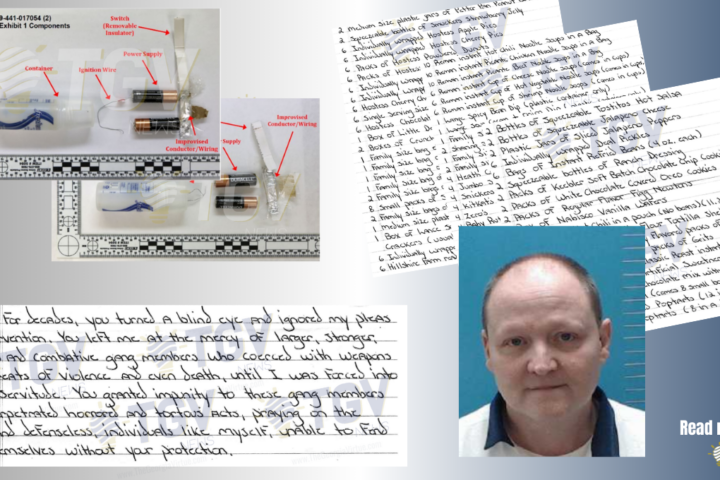
The GBI investigation into Kicklighter’s death led to the arrest of four individuals – Nathan Weekes, Christopher Sumlin, Keisha Jones, and Aerial Murphy – and eventually uncovered a multimillion dollar criminal enterprise operating from behind the walls of Smith SP in Glennville. At the center of the enterprise was a steady influx of contraband, including cell phones, designer clothing, jewelry, drugs, and other items – most often brought into the prison by complicit staff. Over the course of two years that followed the murder, additional murder victims were revealed, including Jesup father and commissary delivery truck driver Jerry Lee Davis, and another former corrections officer, Jessica Jean Gerling. Court records name other GDC staff who were targeted by the criminal enterprise and outline other staff who were arrested on related charges.
Ireon Moore, a GDC employee since March of 2020, was arrested in April 2021 for entering Smith State Prison with $29,000 in cash. While her vehicle was being searched by GDC investigators, her cell phone received a call from an inmate using a contraband phone inside Smith SP. Criminal indictments and court records allege that Moore was romantically involved with at least one inmate at the time of her arrest. She was terminated by GDC following her arrest.
The unraveling of the conspiracy culminated with the arrest of Warden Brian Adams and an excavation of the pond at his residence on GDC-property, which revealed buried contraband.
Weekes, Sumlin, Jones, and Murphy were all charged in Kicklighter’s death, among other things.
Adams was charged with False Statements and Writings, Violation of Oath by a Public Officer, Bribery, and Criminal Attempt – RICO Act. The criminal cases are still pending.
The lawsuit filed in Tattnall County State Court seeks damages from former Warden Brian Adams and former Smith SP Corrections Officer Ireon Moore.
Specifically, the lawsuit contends that the contraband items, including cell phones, narcotics, weapons, designer brand clothing, jewelry, and tobacco should have been noticed by Warden Brian Adams. It also alleges that Ireon Moore was paid to participate in the conspiracy and the financial arrangements were carried out through text message, among other things. You can read more about the suit here.
Sanctions
At issue with the sanctions is an assertion by the Plaintiffs that the Georgia Department of Corrections “engaged in intentional discovery misconduct by making false representations, improperly instructing witnesses not to answer, and withholding relevant evidence.”
Specifically, the Motion for Sanctions contended that the state/GDC “inaccurately represented that no investigation into Mr. Kicklighter’s death had been conducted by the GDC and that GDC had no witness available to testify regarding the majority of the above referenced subpoenaed topics.”
Attorney Brent Savage, who represents the Plaintiffs, wrote in a filing that the Attorney General’s Office “repeatedly instructed witnesses not to answer many questions” and that the witnesses were “not allowed to review or access relevant documents that would have aided in their testimony and were limited to materials hand selected by [the Attorney General’s Office].” At least one issue related to a former GDC/Smith SP employee who sued GDC, but whose lawsuit pleadings were not provided during the discovery process.
The Attorney General’s Office represents the GDC and while GDC is not a direct party to the lawsuit, a number of past and present employees have been subpoenaed for depositions.
Contentious Hearing on Sanctions
In May, Senior Assistant Attorney General Elizabeth appeared before Judge Ronald Hallman, State Court Judge by Designation in Tattnall County, to oppose the Motion for Sanctions against GDC. She was seemingly unprepared to respond to the allegations that the state had obstructed the discovery process.
She said there was “no good faith basis for sanctions” in the case because GDC sent a witness to the deposition, even though that witness testified that he was directed to keep the scope of his document review narrow. In her argument, Crowder lamented that the Department of Corrections was not in possession of documents sought by Savage and the Plaintiffs in another lawsuit.
“I can’t imagine they would have it and not provide it,” she said.
Hallman: “Would the Department of Corrections have copies of the pleadings in the case where the Department of Corrections was a party?”
::11-second pause::
Crowder: “I…the only honest answer that I have is that yes, they would have pleadings, um, internally, the way things are done within the department, the AG’s office, how much information was given by Mr. Webb with regards to that…I did not, I was not aware that she had, I knew that there was an employment lawsuit pending. I did not dive in to find out exactly what that was about in terms of the complaint, but it was my understanding that it was an employment lawsuit and not a ‘contraband into the facility,’ and had nothing to do with Brian Adams specifically, but maybe I was misinformed. And to the extent that I was misinformed, that is on me and I apologize for that. But yes, they would be aware of the fact that a complaint was filed. Yes.”
Hallman then asked Crowder what documents were in the possession of the Attorney General’s Office for the other pending lawsuit.
Savage replied, “Her office defended the case.”
Crowder: “I would point out that I did skim the interrogatories. They are very lengthy. I do not believe that… they are signed under oath. So whether or not they have them, I do not know….”
Hallman: Actually, the State of Georgia would be a party to that case, not just the Department of Corrections, according to the caption of the case.
Crowder: “The State of Georgia?”
Savage: Correct.
Crowder: “The state of Georgia was not a party to the [named deposition that resulted in sanctions.]”
Hallman: “The Court doesn’t like shell games. We’ve got the Department of Corrections and we’ve got the state, the Attorney General, the GBI – it’s all ‘the state.’ And it’s all represented by your office.”
On June 2, Judge Hallman entered a formal order on the sanctions, directing the attorneys for the Plaintiffs to submit affidavits in support of attorney’s fees along with corresponding timesheets.
In his Order, Hallman wrote:
“Despite the duties imposed on it pursuant to Georgia law and a duly issued subpoena, the state failed to produce several hundreds of responsive documents now known to the Court and the parties of this action – including a lawsuit filed by a former Smith State Prison Correctional Officer…in which it was a named Defendant and the allegations related directly to the named-defendants here, the YSL Gang, and the corruption and contraband complained of in this action. That suit was defended by the Attorney General’s Office, Ms. Crowder’s employer. The state also claimed that it had not conducted any investigations into Smith State Prison’s corruption, violations of state law, violations of its own rules and regulations, etc. Finally, and most egregious, the state intentionally limited the scope of their designee’s testimony despite knowing such further testimony and document production was required under Georgia law.”
“…the conduct of the State of Georgia in deliberately ignoring its duties under the law and intentionally obstructing Plaintiffs from engaging in full, meaningful discovery is egregious and sanctionable.”
Lawyers from Savage, Turner, Pinckney, Savage & Sprouse filed supporting documentation seeking a total of $66,717.50 in sanctions and attorneys fees.
Their filing also stated:
“Although Plaintiff is not seeking reimbursement for the time spent opposing Defendants’ motions for summary judgment (since the Court’s June 2 Order did not expressly authorize recovery of those fee), it bears noting that Defendants’ motions were premised in large part on the alleged lack of a fully developed factual record. That deficiency was directly caused by the State of Georgia/ GDC’s failure to comply with third-party discovery obligations. Had the State/GDC fulfilled those duties, Plaintiffs likely would have avoided substantial time and resources spent addressing gaps in the record during the summary judgment phase.”
State Asks Court to Reconsider Order
On June 30, the Attorney General’s Office filed a Motion for Reconsideration, citing the following arguments:
- The Court did not issue a formal order requiring the state to comply with the discovery process.
- The Plaintiffs (through their attorney) ‘mischaracterized’ GDC’s efforts to ‘cooperate with Plaintiff’
- The State of Georgia was never served with a subpoena, only the Georgia Department of Corrections was served.
- Plaintiffs fail to demonstrate that their fees and costs are reasonable and necessary.
- The state argues that they’re entitled to a hearing on the attorneys fees and should have the opportunity to challenge the fees and their ‘reasonableness.’ They stated the submitted timesheet records and sworn affidavits are not sufficient for cross-examination.
- Plaintiffs entire theory of recovery for attorney’s fees or sanctions against the State of Georgia relies upon a theory that assumes that each and every attorney that works in the Attorney General’s Office has knowledge of the cases that every other attorney within the office is handling.
The AG’s office further argued that the court’s ruling was based on ‘a misunderstanding of the facts and circumstances necessary to uphold findings.’
The Motion was signed by Attorney General Chris Carr, Deputy Attorney General Beth Burton, and Senior Assistant Attorney General Elizabeth Crowder.