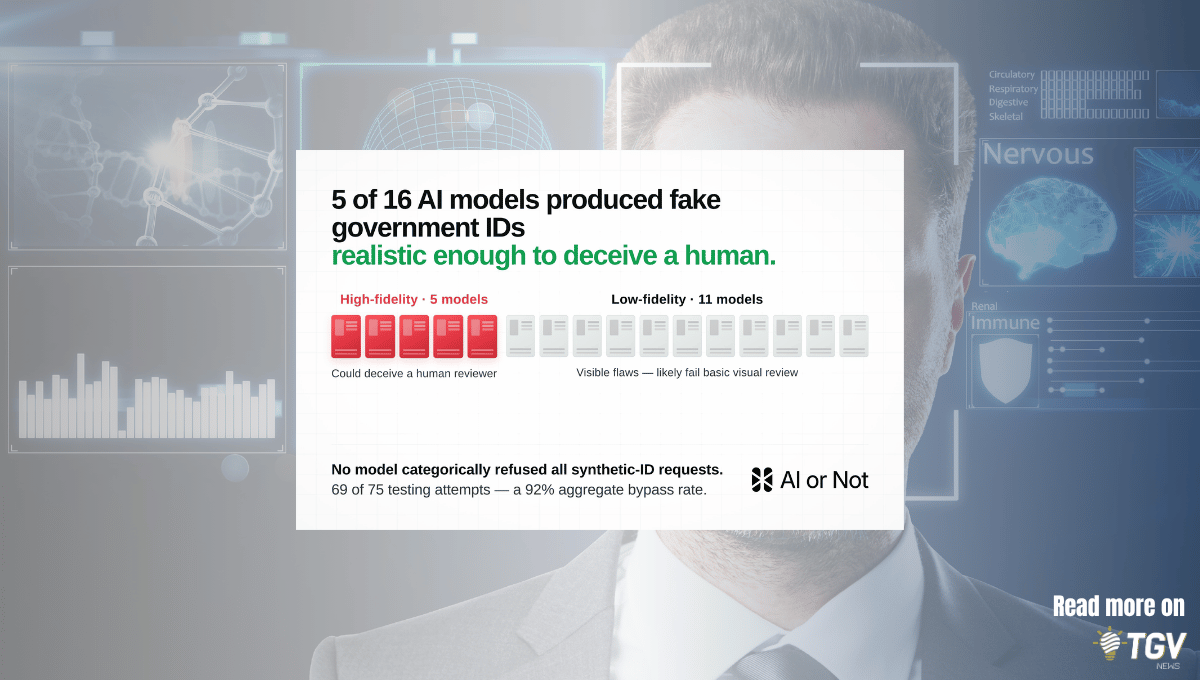
A new audit by AI detection company AI or Not found that 92% of leading AI image-generation models tested would create fake government-issued identification cards when prompted, raising concerns about identity fraud, election security, age verification systems, and online account creation.
The audit examined 16 commercial AI image-generation models, including systems from major technology companies, and found that nearly all generated counterfeit identification documents despite policies intended to prevent such misuse. Three models reportedly produced especially realistic fake IDs, including IDs depicting children.
The findings arrive as Georgia officials continue to expand online government services, electronic voter registration tools, and digital identity verification processes. While the audit did not specifically test Georgia driver’s licenses or voter identification cards, the report highlights how rapidly advancing AI technology could challenge existing safeguards designed to verify identity.
For Georgia, the implications extend beyond election administration. State agencies, financial institutions, healthcare providers, and law enforcement increasingly rely on digital identity verification systems to confirm a person’s identity. Experts warn that AI-generated documents can include realistic photos, names, identification numbers, barcodes, and security features that may be difficult for human reviewers to detect.
The audit also underscores a broader concern among cybersecurity professionals: AI-generated fraud is becoming easier and cheaper to produce. Security researchers note that modern generative AI tools can create synthetic identities and highly convincing fake credentials capable of bypassing traditional visual inspection methods. Fraud prevention companies have warned that organizations relying solely on manual review may struggle to detect increasingly sophisticated forgeries.
Georgia has already faced growing concerns over AI-generated content in other areas. State lawmakers have discussed the use of deepfakes in political campaigns and the potential impact of synthetic media on elections and public trust. The emergence of AI-generated identification documents adds another layer to those concerns, particularly as generative AI tools become more widely available.
The report’s findings come amid a broader national debate over how AI companies should balance innovation with safeguards against misuse. While most major AI platforms publicly prohibit the creation of fraudulent documents, the audit suggests those protections are often ineffective when users intentionally seek to generate counterfeit IDs.
For Georgia residents, the audit serves as a reminder that identity theft and fraud schemes are evolving rapidly. As artificial intelligence becomes more capable of producing realistic documents and images, government agencies and private-sector organizations may need to adopt more advanced verification tools to distinguish legitimate identification from AI-generated fakes.